
Opus Roman Pattern
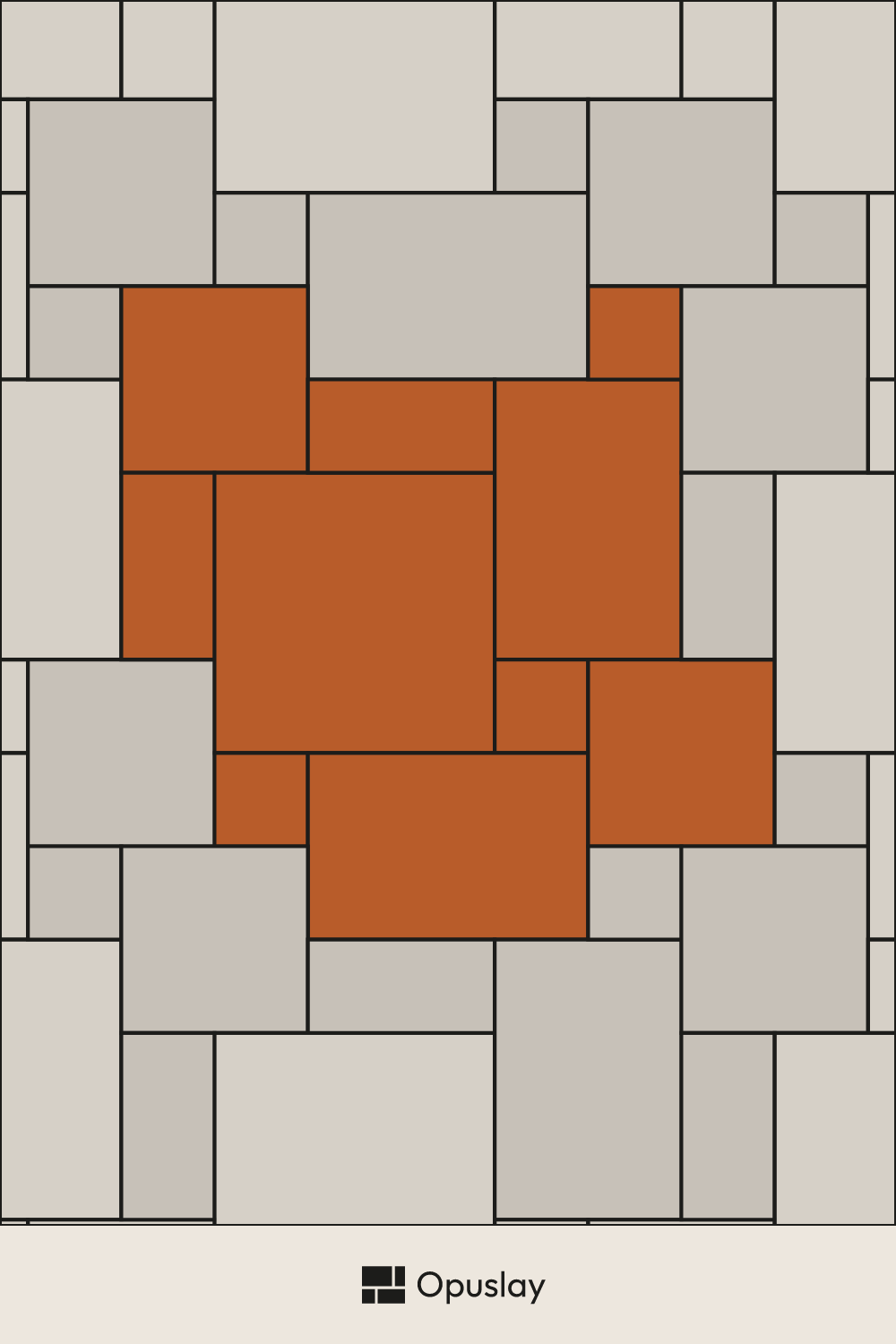
The Opus Roman pattern — also called Opus Romano — is a modular tile layout that combines five tile sizes into a single repeating module: 8"x8", 8"x16", 16"x16", 16"x24", and 24"x24". Unlike the closely related Versailles pattern, which uses four sizes, Opus Roman adds the larger 24x24 tile to the mix, producing a bolder, more contemporary take on the same ancient Roman layout principle. The Ashlar pattern draws on the very same five sizes, but arranges them into an eleven-tile module deliberately built to hide its repeat — the same shopping list, a far less regular floor.
Last updated: 2026-07-07
Opus Roman Pattern
Opuslay — tile layout worksheet- Room:
- 3 m × 2.5 m
- Units:
- Metric (cm / m²)
- Anchor:
- Left · Top
- Layout angle:
- Straight
- Tile colours:
- Single colour
Material breakdown
| Format | Qty / Pattern | Share | Qty / Room | Area / Room |
|---|---|---|---|---|
| 40x40 cm | 2 | 22.2% | 15 | 1.88 m² |
| 20x40 cm | 2 | 11.1% | 12 | 0.88 m² |
| 60x60 cm | 1 | 25.0% | 6 | 1.92 m² |
| 40x60 cm | 2 | 33.3% | 13 | 2.22 m² |
| 20x20 cm | 3 | 8.3% | 16 | 0.60 m² |
| Total | 10 | 100% | 62 | 7.50 m² |
What you'll need to buy
Tiles to buy
| 20x20 cm | 16 tiles | 0.64 m² |
| 20x40 cm | 12 tiles | 0.96 m² |
| 40x40 cm | 15 tiles | 2.40 m² |
| 40x60 cm | 13 tiles | 3.12 m² |
| 60x60 cm | 7 tiles | 2.52 m² |
Total 63 tiles · 9.64 m² (incl. 29% cuts & breakage)
Adhesive & grout
- Thin-set adhesive: ≈ 40.5 kg (2 × 50 lb bags) — recommended trowel: 12mm notch, large format
- Grout — the tile sets the joint width, not you:
- ≈ 1.7 kg (1 × 10 lb bag) — 3mm joint, rectified / tight-set tile
- ≈ 2.9 kg (1 × 10 lb bag) — 5mm joint, natural or non-rectified tile
Adhesive: allow a little over on an uneven substrate, or if you back-butter large tiles — both eat more than a flat bed.
Grout: the 25 lb bag is the usual size (10 lb for small jobs). Buy it in one go and stick to a single bag size: bags from different batches can dry to slightly different shades.
It's the tile that decides the joint, not the setter — dry-lay a section to find your width. Assumes 9.5mm tile depth; adjust for your product — thicker tiles need more.
Share & export
Save the Opus Roman Pattern layout to your moodboard, or send the link to your tiler — it reopens with your room dimensions.

About the Opus Roman Pattern
The name refers to ancient Roman flooring techniques known as "opus" (Latin for "work"), where stone tiles of varying sizes were combined according to a fixed, repeatable scheme rather than laid randomly.
Modern Opus Roman patterns are sold as pre-cut tile sets by natural stone and porcelain suppliers, and the exact size mix can vary by project. Some installers prefer the simplified 3-size version, dropping the two smallest tiles for a bolder, less busy look, while others lean toward the plank-format version, which swaps the classic square-leaning proportions for elongated wood-look sizes — both follow the same fixed, repeating module principle as the full five-size layout.
Every size in an Opus Roman module is a grid dimension — the tile plus its grout joint — and with five sizes interlocking on a fixed module, the joints are what let them add up. The calculator counts these grid cells, so the count is exact. Opus Roman sets are usually travertine, limestone or stone-look porcelain and are rarely rectified, so real tiles vary slightly from nominal; a slightly wider joint absorbs that, and it's worth measuring your actual tiles before committing to a joint width.
Frequently Asked Questions
What is the difference between Opus Roman and Versailles pattern?
Both use the same underlying principle of a repeating multi-size module, but the classic Versailles pattern uses four tile sizes (8x8, 8x16, 16x16, 16x24), while this Opus Roman layout adds a fifth, larger 24x24 tile for a bolder large-format look.
Is Opus Romano the same as Opus Roman pattern?
Yes — Opus Roman and Opus Romano are used interchangeably to describe the same family of fixed multi-size modular tile layouts.
How much waste should I allow for an Opus Roman pattern?
Most installers recommend 10-15% waste for an Opus Roman layout, similar to other multi-size modular patterns, to account for the extra cuts needed across five different tile sizes at room edges.
Can Opus Roman pattern be laid with porcelain tile?
Yes — while the pattern originated with natural stone like travertine and limestone, many porcelain manufacturers now offer the same five-size sets specifically to replicate an Opus Roman layout.
Do all suppliers use the exact same tile ratio for Opus Roman pattern?
Not always — the precise ratio of pieces per size can vary slightly between suppliers, so it's worth confirming the exact module before ordering tile for a large area.
How wide should the grout joints be in an Opus Roman pattern?
Five sizes have to interlock, so the joints do more work than in a single-size floor, and Opus Roman sets — often travertine, limestone or stone-look porcelain — are rarely rectified, so a joint around 3/16" gives that natural size variation somewhere to go. ANSI A108.02 §4.3.8 sets the floor — at least three times the tiles' size variation, never under 1/16", with the larger 16x24 and 24x24 pieces in the over-15" range where a 1/8"–3/16" minimum applies — but the multi-size fit is our own point: dry-lay a section and measure your actual tiles first, since a five-size grid is far less forgiving than a plain running bond.