
Ashlar Pattern
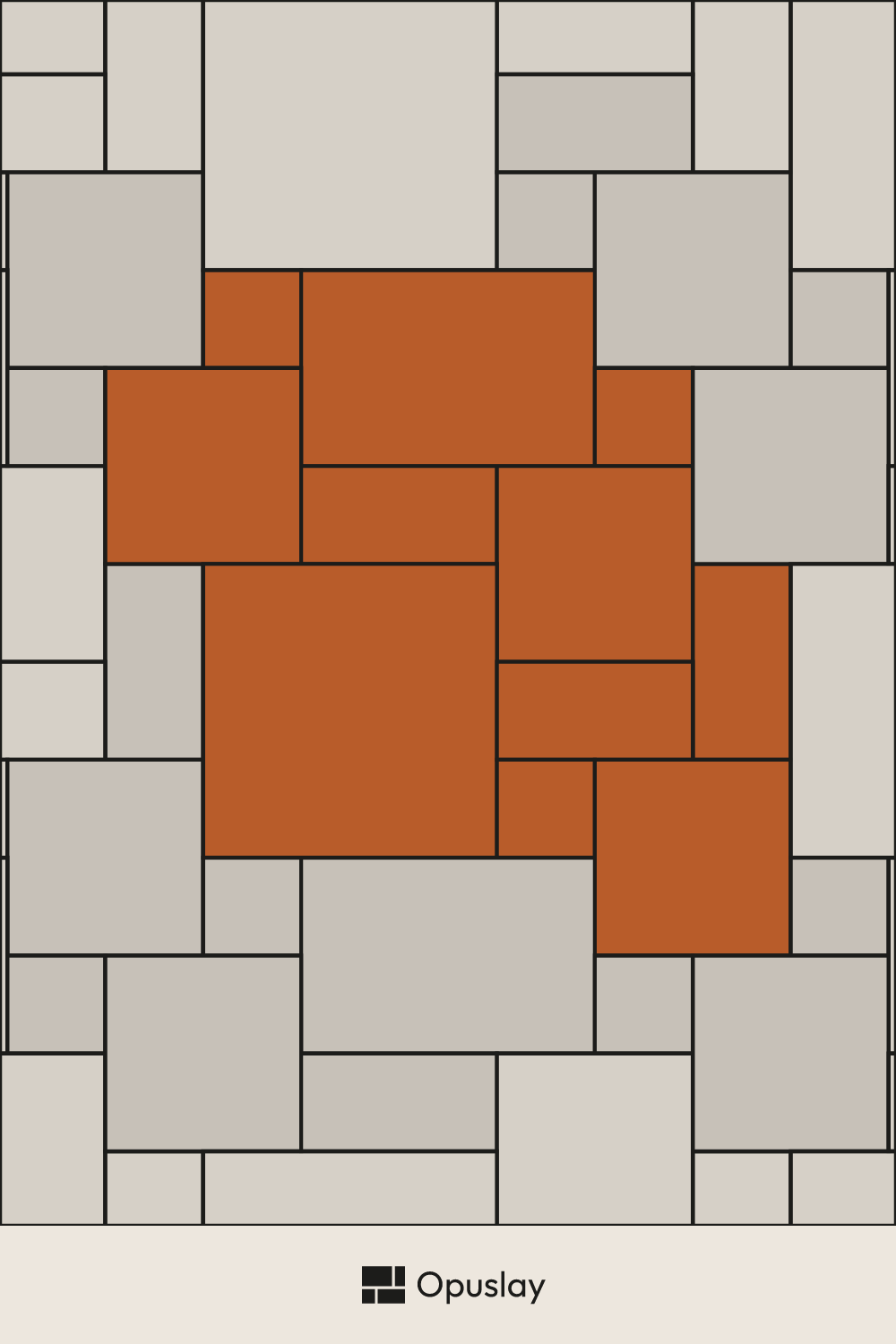
The Ashlar pattern combines five tile sizes — 8"x8", 8"x16", 16"x16", 16"x24", and 24"x24" — into an eleven-tile module designed to look randomly assembled, without the straight running joints of a single-size layout. Unlike a truly random installation, the module still repeats on a fixed 48"x48" grid, so quantities can be ordered and cut lists planned in advance.
Last updated: 2026-07-06
Ashlar Pattern
Opuslay — tile layout worksheet- Room:
- 3 m × 2.5 m
- Units:
- Metric (cm / m²)
- Anchor:
- Left · Top
- Layout angle:
- Straight
- Tile colours:
- Single colour
Material breakdown
| Format | Qty / Pattern | Share | Qty / Room | Area / Room |
|---|---|---|---|---|
| 20x20 cm | 3 | 8.3% | 17 | 0.62 m² |
| 40x60 cm | 1 | 16.7% | 9 | 1.26 m² |
| 40x40 cm | 3 | 33.3% | 19 | 2.50 m² |
| 20x40 cm | 3 | 16.7% | 16 | 1.20 m² |
| 60x60 cm | 1 | 25.0% | 6 | 1.92 m² |
| Total | 11 | 100% | 67 | 7.50 m² |
What you'll need to buy
Tiles to buy
| 20x20 cm | 17 tiles | 0.68 m² |
| 20x40 cm | 17 tiles | 1.36 m² |
| 40x40 cm | 20 tiles | 3.20 m² |
| 40x60 cm | 8 tiles | 1.92 m² |
| 60x60 cm | 7 tiles | 2.52 m² |
Total 69 tiles · 9.68 m² (incl. 29% cuts & breakage)
Adhesive & grout
- Thin-set adhesive: ≈ 40.5 kg (2 × 50 lb bags) — recommended trowel: 12mm notch, large format
- Grout — the tile sets the joint width, not you:
- ≈ 1.8 kg (1 × 10 lb bag) — 3mm joint, rectified / tight-set tile
- ≈ 3.0 kg (1 × 10 lb bag) — 5mm joint, natural or non-rectified tile
Adhesive: allow a little over on an uneven substrate, or if you back-butter large tiles — both eat more than a flat bed.
Grout: the 25 lb bag is the usual size (10 lb for small jobs). Buy it in one go and stick to a single bag size: bags from different batches can dry to slightly different shades.
It's the tile that decides the joint, not the setter — dry-lay a section to find your width. Assumes 9.5mm tile depth; adjust for your product — thicker tiles need more.
Share & export
Save the Ashlar Pattern layout to your moodboard, or send the link to your tiler — it reopens with your room dimensions.

About the Ashlar Pattern
"Ashlar" borrows its name from quarried stonework laid in a deliberately irregular, non-uniform bond — tile manufacturers adapted the term for modular multi-size layouts that reproduce that same organic, unstructured look.
Combining more tile sizes into a single repeating module — as opposed to a two- or three-size layout — pushes the irregular illusion further while keeping the installation buildable from a known, repeatable set of pieces.
Every size in an Ashlar module is a grid dimension — the tile plus its grout joint — and because five sizes have to interlock on a fixed 48x48 module, the joints are what let them line up. The calculator counts these grid cells, so the count is exact. Ashlar sets are usually natural stone or stone-look porcelain and are rarely rectified, so the real tiles vary slightly from nominal; a slightly wider joint absorbs that variation, and it's worth measuring your actual tiles before committing to a joint width.
Frequently Asked Questions
What is an Ashlar tile pattern?
A modular layout that mixes several tile sizes — in this case 8x8, 8x16, 16x16, 16x24, and 24x24 — to create the look of a random stone bond, while still repeating on a fixed, plannable module.
Is ashlar a stone pattern or a tile pattern?
Both — and the tile layout borrows its name from the stonework. In masonry, ashlar means squared, dressed stone laid in courses, often with blocks of differing heights so the joints break irregularly instead of lining up. Tile makers took the term for modular layouts that reproduce that look with factory sizes: here, five of them in an eleven-tile module. If you arrived from a stone reference, the idea is the one you had in mind — the difference is that a tile version repeats on a fixed module, so it can be counted size by size before you order.
Is Ashlar pattern really random?
No — it only looks that way. The eleven-tile module repeats every 48"x48", which is what makes it possible to calculate exact quantities per tile size rather than ordering blind for a true random layout.
How much waste should I allow for an Ashlar pattern?
Similar to Versailles/French pattern — typically 10-15% waste — to account for the extra cuts needed at room edges across five different tile sizes.
How is Ashlar different from Versailles / French pattern?
Versailles uses four tile sizes; this Ashlar layout adds a fifth (24x24) and a larger, more irregular-looking eleven-tile module — both are modular multi-size layouts, but Ashlar is built to look less obviously repeating.
How wide should the grout joints be in an Ashlar pattern?
Because five sizes have to interlock, the joints do more work than in a single-size floor, and Ashlar sets — often travertine or stone-look porcelain — are rarely rectified, so a joint around 3/16" gives that natural size variation somewhere to go. ANSI A108.02 §4.3.8 sets the floor — at least three times the tiles' size variation, never under 1/16", with the larger 16x24 and 24x24 pieces in the over-15" range where a 1/8"–3/16" minimum applies — but the multi-size fit is our own point: dry-lay a section and measure your actual tiles first, since a five-size grid is far less forgiving than a plain running bond.