
Opus Roman Pattern — 8x32, 16x32 & 32x32 (Plank Format)
This Opus Roman variant uses a set of three elongated plank-format tile sizes — 8"x32", 16"x32", and 32"x32" — following the same fixed-module principle as the classic 5-size Opus Roman pattern, but built entirely from long, narrow proportions rather than the more square-leaning sizes of the traditional layout.
Last updated: 2026-07-07
Plank-Format Opus Roman Pattern
Opuslay — tile layout worksheet- Room:
- 3 m × 2.5 m
- Units:
- Metric (cm / m²)
- Anchor:
- Left · Top
- Layout angle:
- Straight
- Tile colours:
- Single colour
Material breakdown
| Format | Qty / Pattern | Share | Qty / Room | Area / Room |
|---|---|---|---|---|
| 20x80 cm | 1 | 14.3% | 8 | 0.98 m² |
| 80x80 cm | 1 | 57.1% | 9 | 4.36 m² |
| 40x80 cm | 1 | 28.6% | 8 | 2.16 m² |
| Total | 3 | 100% | 25 | 7.50 m² |
What you'll need to buy
Tiles to buy
| 20x80 cm | 8 tiles | 1.28 m² |
| 40x80 cm | 9 tiles | 2.88 m² |
| 80x80 cm | 9 tiles | 5.76 m² |
Total 26 tiles · 9.92 m² (incl. 32% cuts & breakage)
Adhesive & grout
- Thin-set adhesive: ≈ 40.5 kg (2 × 50 lb bags) — recommended trowel: 12mm notch, large format
- Grout — the tile sets the joint width, not you:
- ≈ 1.1 kg (1 × 10 lb bag) — 3mm joint, rectified / tight-set tile
- ≈ 1.9 kg (1 × 10 lb bag) — 5mm joint, natural or non-rectified tile
Adhesive: allow a little over on an uneven substrate, or if you back-butter large tiles — both eat more than a flat bed.
Grout: the 25 lb bag is the usual size (10 lb for small jobs). Buy it in one go and stick to a single bag size: bags from different batches can dry to slightly different shades.
It's the tile that decides the joint, not the setter — dry-lay a section to find your width. Assumes 9.5mm tile depth; adjust for your product — thicker tiles need more.
Share & export
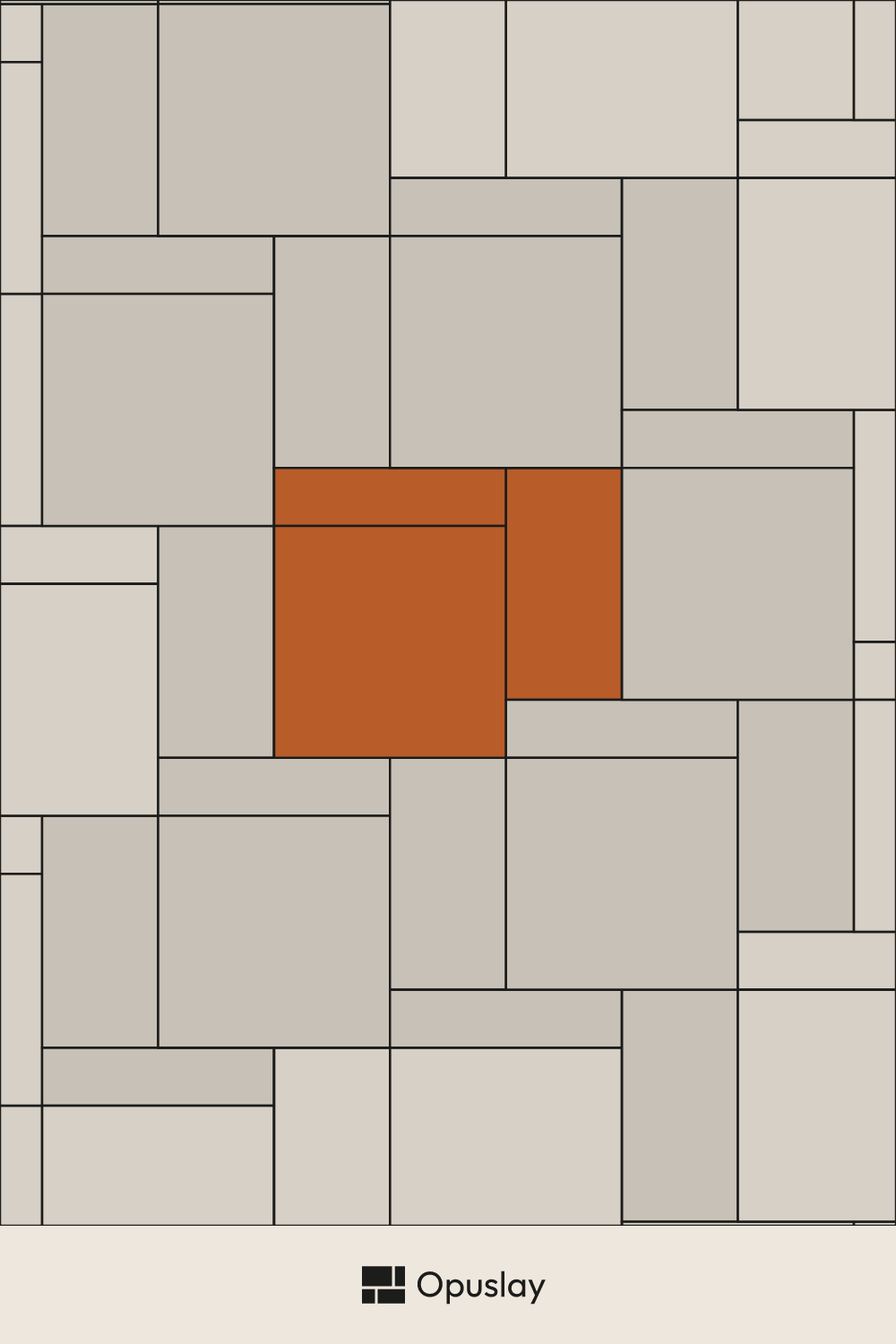
Save the Plank-Format Opus Roman Pattern layout to your moodboard, or send the link to your tiler — it reopens with your room dimensions.

About the Plank-Format Opus Roman Pattern
As wide plank-format porcelain tile grew popular for its wood-look and large-format appeal, some manufacturers adapted the Opus Roman modular principle to these elongated proportions instead of the traditional stone-derived square and near-square sizes.
The result keeps the same repeating, non-random logic as classic Opus Roman, but reads as a more linear, contemporary floor rather than the traditional stone-inspired look. Installers who want that modular logic in a large-square register — without committing to the full five-size module — can compare the 3-size square-format Opus Roman variant, which uses only the three largest sizes from the original set.
Frequently Asked Questions
Is this plank-based layout still called Opus Roman pattern?
Yes — it follows the same fixed multi-size repeating module principle as classic Opus Roman, just applied to elongated plank-format tile sizes instead of the traditional square-leaning sizes.
How much waste should I allow for this plank Opus pattern?
A 10-15% waste allowance is typical for this layout, consistent with other modular multi-size patterns.
Can this pattern be used with wood-look porcelain tile?
Yes — this plank-format Opus variant is commonly used with wood-look porcelain, since the elongated proportions suit that aesthetic well.
What's the difference between this pattern and the classic Opus Roman module?
The classic Opus Roman module (8x8, 8x16, 16x16, 16x24, 24x24) leans toward square proportions typical of stone flooring, while this variant uses three elongated plank sizes (8x32, 16x32, 32x32) for a more linear, contemporary look.