
4x4 Tile Pattern
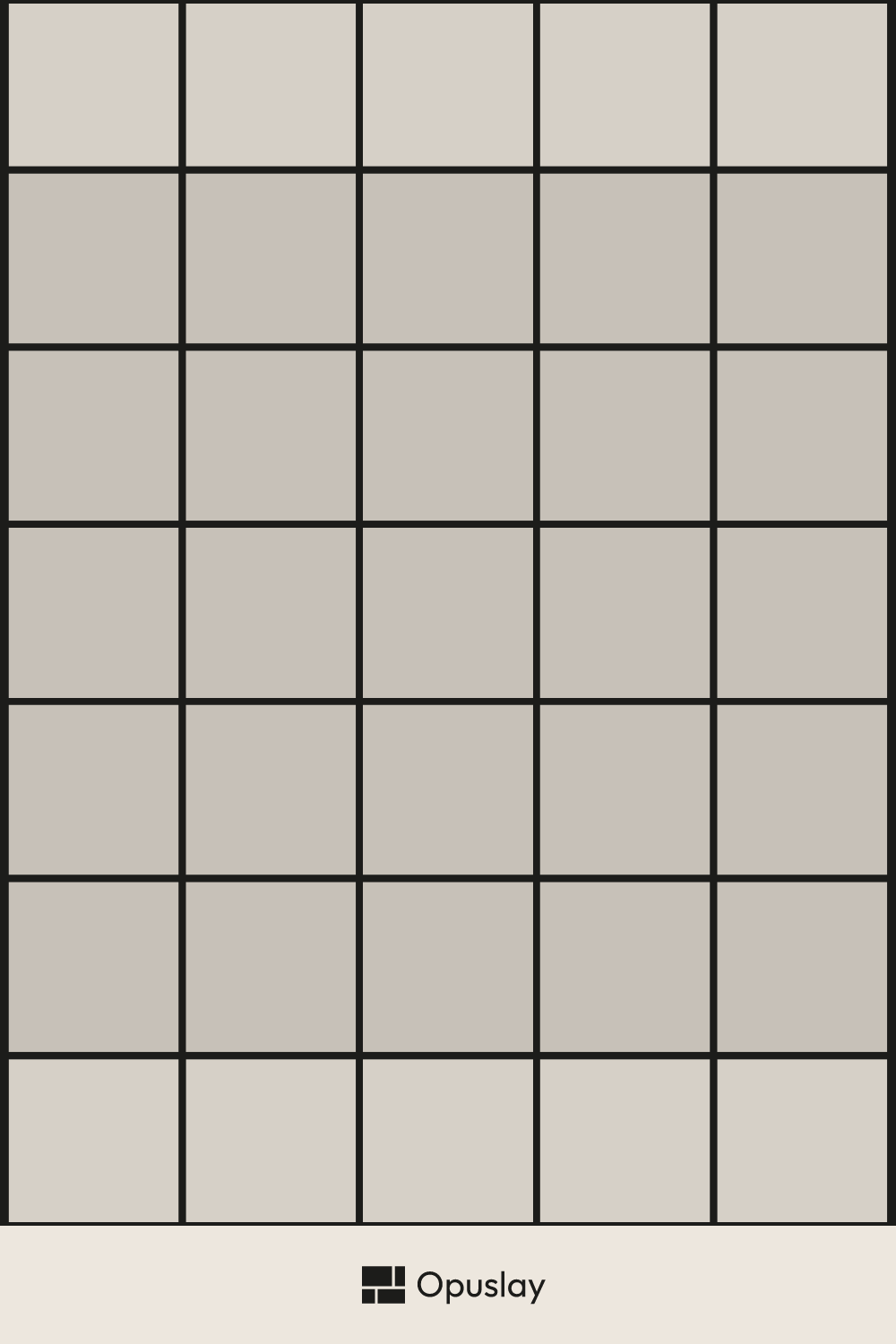
The 4x4 tile pattern in a stack bond sets 4x4 squares on a straight grid, with every joint lining up in both directions to form an unbroken vertical and horizontal grid. It is the default layout for a small square tile: the format is compact enough that an offset adds little visual interest, while the aligned grid reads as deliberate and lets the tile itself — its color, glaze, or surface variation — carry the wall. The same layout works for any 4x4 tile, from a flat machine-made ceramic to a handmade zellige.
Last updated: 2026-08-14
4x4 Tile Pattern
Opuslay — tile layout worksheet- Room:
- 3 m × 2.5 m
- Units:
- Metric (cm / m²)
- Anchor:
- Left · Top
- Layout angle:
- Straight
- Tile colours:
- Single colour
Material breakdown
| Format | Qty / Pattern | Share | Qty / Room | Area / Room |
|---|---|---|---|---|
| 10x10 cm | 1 | 100.0% | 750 | 7.50 m² |
| Total | 1 | 100% | 750 | 7.50 m² |
What you'll need to buy
Tiles to buy
| 10x10 cm | 788 tiles | 7.88 m² |
Total 788 tiles · 7.88 m² (incl. 5% cuts & breakage)
Adhesive & grout
- Thin-set adhesive: ≈ 20.3 kg (1 × 50 lb bag) — recommended trowel: 6mm notch
- Grout — the tile sets the joint width, not you:
- ≈ 6.8 kg (1 × 25 lb bag) — 3mm joint, rectified / tight-set tile
- ≈ 11.4 kg (2 × 25 lb bags) — 5mm joint, natural or non-rectified tile
Adhesive: allow a little over on an uneven substrate, or if you back-butter large tiles — both eat more than a flat bed.
Grout: the 25 lb bag is the usual size (10 lb for small jobs). Buy it in one go and stick to a single bag size: bags from different batches can dry to slightly different shades.
It's the tile that decides the joint, not the setter — dry-lay a section to find your width. Assumes 9.5mm tile depth; adjust for your product — thicker tiles need more.
Share & export
Save the 4x4 Tile Pattern layout to your moodboard, or send the link to your tiler — it reopens with your room dimensions.

About the 4x4 Tile Pattern
The 4x4 glazed square is one of the most familiar formats on American kitchen and bathroom walls, and its stack bond grid is what most people picture when they think of a plain tiled wall. Because the module is a simple square, the layout tessellates on a straight grid with no offset to calculate — the only real design decision is where the grid starts, which is what determines the size of the cuts at each wall, exactly as it does for its bigger sibling, the 12x12.
A 4x4 tile shows up most in small, bounded areas rather than across an open floor: a kitchen backsplash, the walls of a shower enclosure, a half-bath floor, a fireplace surround. Those spaces are fixed by fixtures on at least two sides, and a small square tile leaves smaller, less noticeable cuts at those edges than a larger format would. Straight stack bond is standard rather than an offset for a simple reason: the module is already square, so shifting alternate rows sideways changes little about how it reads. What actually decides the size of the cuts around the room is where the grid starts — center the first row on the longest wall, or align it to a fixed edge like a tub, and the calculator lays out the rest from there.
Frequently Asked Questions
How many 4x4 tiles are in a square foot?
A little over nine. The nominal math says nine — a 4"x4" covers 16 square inches and a square foot is 144 — but like most square tile today, a nominal 4x4 is made metric: it runs on a 100 mm grid, tile plus its grout joint, which works out to roughly 9.3 tiles per square foot. Opuslay sidesteps the arithmetic entirely by laying the grid out against your actual room and counting whole tiles and cuts.
Where is 4x4 tile typically used?
Backsplashes, shower walls and smaller bathroom floors are the classic settings — the format is compact enough to work well in a tight space and around fixtures, without the large cuts a bigger tile would leave at a sink splash or a narrow return wall. It's less common on an open living-area floor today, where larger formats read as more contemporary, but it hasn't disappeared from that use either.
Should 4x4 tile be stacked or offset?
Stack bond is the more common choice. On a square tile, a running bond shifts every other row by half a tile but the module stays square, so the offset reads as a subtle stagger rather than a brick pattern. Stacked keeps the grid clean and puts the emphasis on the tile.
Is 4x4 tile outdated?
Search interest suggests the opposite. The format went quiet for years while large-format tile dominated, but it's come back on handmade and textured tile — including zellige, one of the most-searched tile terms in the US — where the small square and its visible grid are the look rather than a compromise.