
1/3 Offset Tile Pattern (1/3 Running Bond)
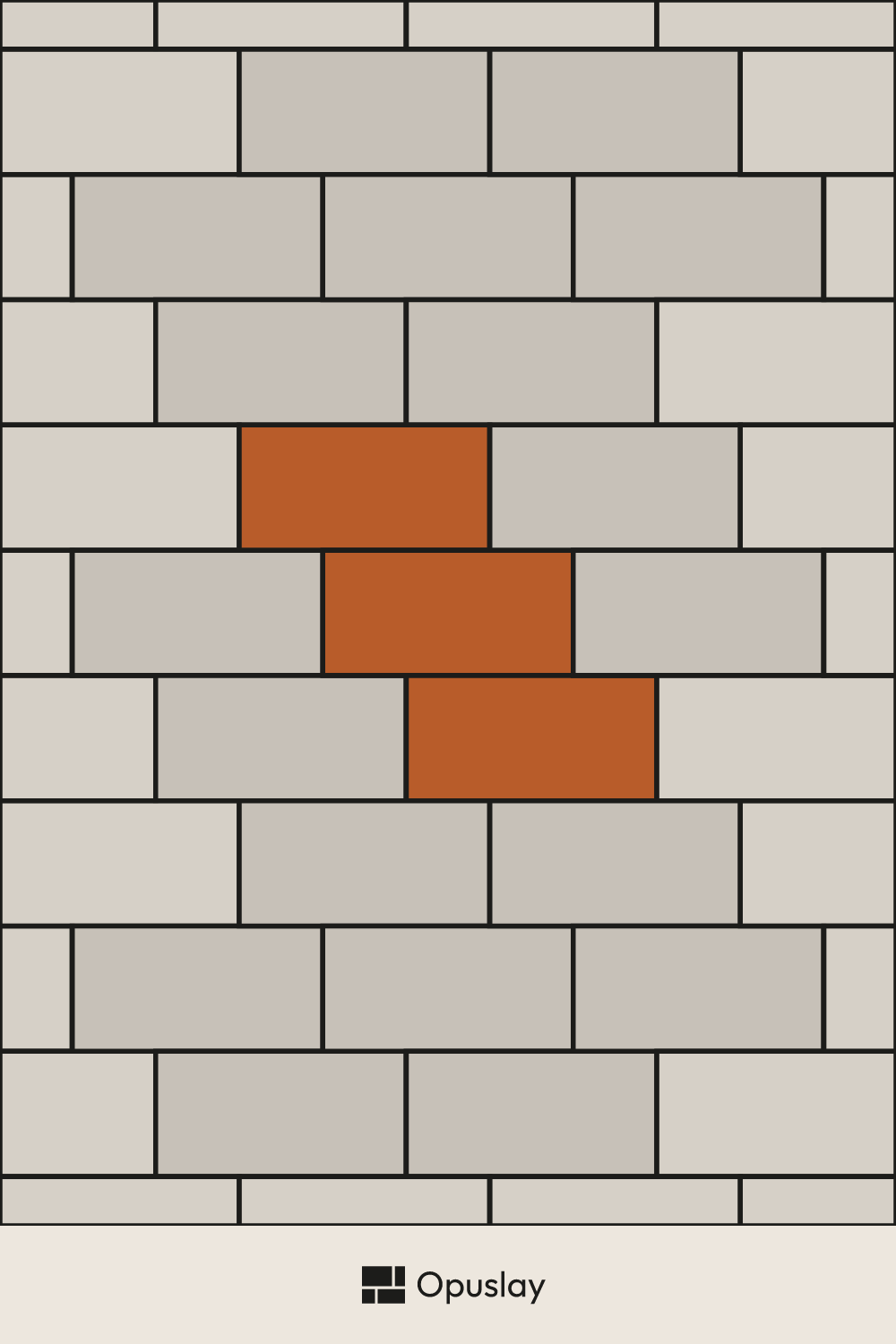
A 1/3 offset tile pattern — also called a 1/3 running bond, a 33% offset or a staggered third — shifts each row by a third of the tile length instead of half, so the end joints step across three rows before they line up again. It has become the default layout for large-format rectangular tile, the 12x24 above all, because a half offset puts each end joint right where the neighboring tile is most likely to bow.
Last updated: 2026-11-12
12x24 1/3 Offset Running Bond
Opuslay — tile layout worksheet- Room:
- 10' × 8'
- Units:
- Imperial (ft / in)
- Anchor:
- Left · Top
- Layout angle:
- Straight
- Tile colours:
- Single colour
Material breakdown
| Format | Qty / Pattern | Share | Qty / Room | Area / Room |
|---|---|---|---|---|
| 12x24 in | 3 | 100.0% | 54 | 80.0 sq ft |
| Total | 3 | 100% | 54 | 80.0 sq ft |
What you'll need to buy
Tiles to buy
| 12x24 in | 50 tiles | 96.9 sq ft |
Total 50 tiles · 96.9 sq ft (incl. 21% cuts & breakage)
Adhesive & grout
- Thin-set adhesive: ≈ 88.5 lb (2 × 50 lb bags) — recommended trowel: 1/2"x1/2" (12mm) notch, large format
- Grout — the tile sets the joint width, not you:
- ≈ 3.7 lb (1 × 10 lb bag) — 3mm (1/8") joint, rectified / tight-set tile
- ≈ 6.2 lb (1 × 10 lb bag) — 5mm (3/16") joint, natural or non-rectified tile
Adhesive: allow a little over on an uneven substrate, or if you back-butter large tiles — both eat more than a flat bed.
Grout: the 25 lb bag is the usual size (10 lb for small jobs). Buy it in one go and stick to a single bag size: bags from different batches can dry to slightly different shades.
It's the tile that decides the joint, not the setter — dry-lay a section to find your width. Assumes 9.5mm (3/8") tile depth; adjust for your product — thicker tiles need more.
Share & export
Save the 12x24 1/3 Offset Running Bond layout to your moodboard, or send the link to your tiler — it reopens with your room dimensions.

Why a third, not a half
Porcelain tile longer than about 18 inches is rarely perfectly flat: firing leaves most of it with a slight crown or dip at the center. In a half offset, the center of one tile meets the end of the next — the highest point against the lowest — and the step shows as lippage. Moving the joint to a third shrinks that mismatch.
The US installation standard, ANSI A108.02, makes it the rule: when the offset side of the tile is longer than 18 inches, the running bond offset is limited to 33% unless the tile manufacturer specifies otherwise. Check the carton before you snap your lines: some manufacturers ask for less, 20 to 25%.
The same third at every size
The rule is about tile length, but the look works at any scale. On walls, a third suits narrow planks like 4x16 and 6x24; on floors, it is the usual layout for 12x24 and longer 9x36 and 8x48 planks. Square tiles can be set at a third too, in an 18x18 or 24x24 running bond.
Frequently Asked Questions
Is a 1/3 offset the same as a 1/3 running bond?
Yes. 1/3 offset, 1/3 running bond, 33% offset and staggered third all name the same layout: each row shifted by a third of the tile length. Running bond is the general name for any staggered brick-style layout; the fraction says how far each row moves.
Should I use a 1/3 or a 1/2 offset?
For tile longer than 18 inches, a third — that is what the installation standard and most manufacturers call for, to keep lippage down. The half offset stays the classic for small, flat tile like a 3x6 subway, where warpage is not a concern and the brick look is the point.
How do I mark a 1/3 offset?
Divide the actual tile length plus one grout joint by three — not the nominal size. A 12x24 often measures closer to 23.5 inches, so the step is about 8 inches. Mark it on a reference row, then repeat: the pattern comes back to its starting position every three rows.
Does a 1/3 offset waste more tile?
Not by itself. The offcut at the end of one row can often start a row further along, just as in a half offset. What drives waste is how the rows land against your walls, which is why Opuslay lays the pattern out on your actual room and counts the cuts it finds.