
600x600 Tile Pattern
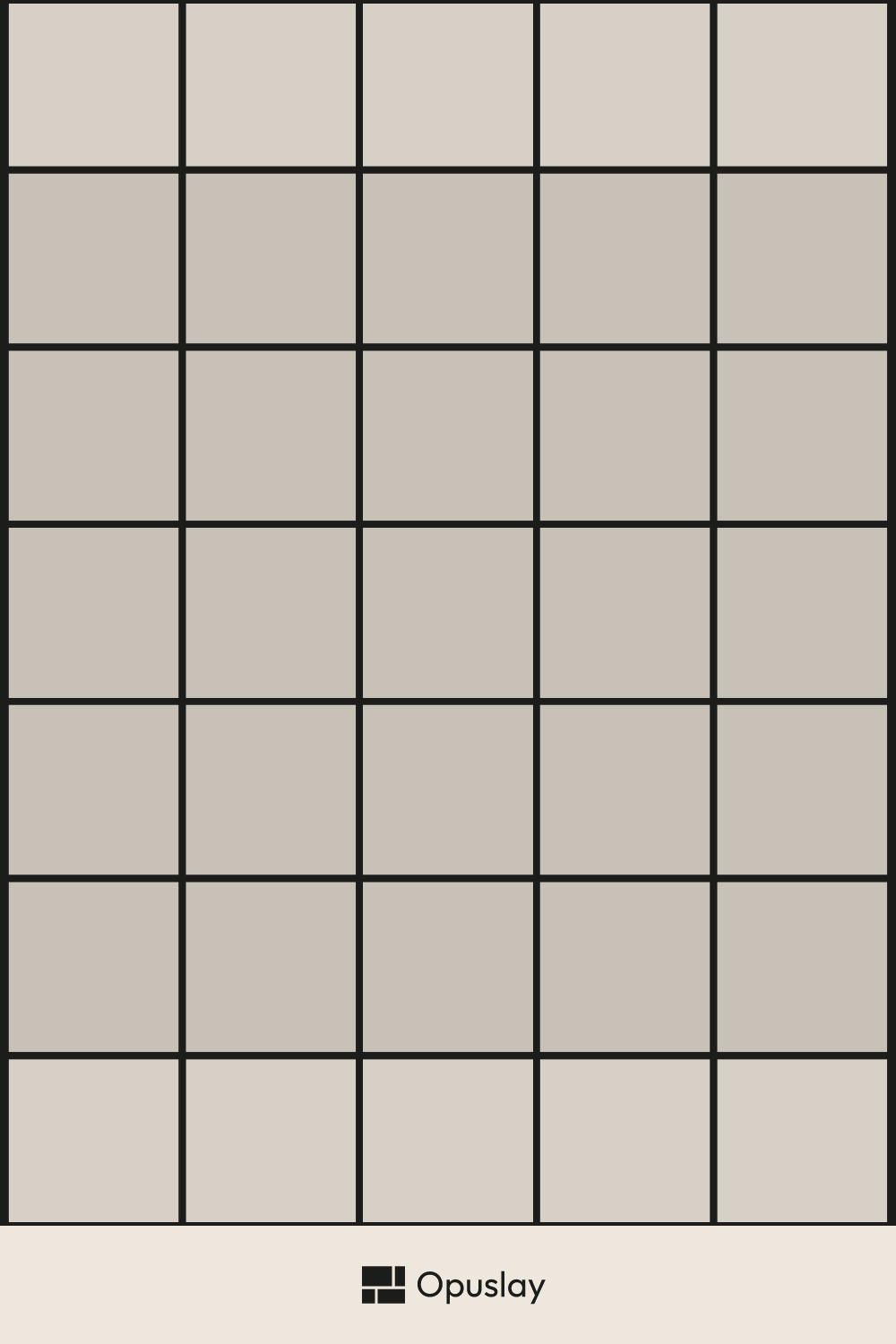
The 600x600 stack bond pattern lays a single 600x600 tile with no offset between rows, producing a clean architectural grid — the layout most commonly used for this large-format porcelain tile, which has become a favourite for both floors and walls.
Last updated: 2026-07-12
600x600 tile pattern
Opuslay — tile layout worksheet- Room:
- 3 m × 2.5 m
- Units:
- Metric (mm / m²)
- Anchor:
- Left · Top
- Layout angle:
- Straight
- Tile colours:
- Single colour
Material breakdown
| Format | Qty / Pattern | Share | Qty / Room | Area / Room |
|---|---|---|---|---|
| 600x600 mm | 1 | 100.0% | 25 | 7.50 m² |
| Total | 1 | 100% | 25 | 7.50 m² |
What you'll need to buy
Tiles to buy
| 600x600 mm | 25 tiles | 9.00 m² |
Total 25 tiles · 9.00 m² (incl. 20% cuts & breakage)
Adhesive & grout
- Thin-set adhesive: ≈ 40.5 kg (3 × 20 kg bags) — recommended trowel: 12mm notch, large format
- Grout — the tile sets the joint width, not you:
- ≈ 1.1 kg (1 × 2.5 kg bag) — 3mm joint, rectified / tight-set tile
- ≈ 1.9 kg (1 × 2.5 kg bag) — 5mm joint, natural or non-rectified tile
Adhesive: allow a little over on an uneven substrate, or if you back-butter large tiles — both eat more than a flat bed.
Grout: bag sizes vary by brand — 10 kg is a common one (2.5 kg for small jobs). Buy it in one go and stick to a single bag size: bags from different batches can dry to slightly different shades.
It's the tile that decides the joint, not the setter — dry-lay a section to find your width. Assumes 9.5mm tile depth; adjust for your product — thicker tiles need more.
Share & export
Save the 600x600 tile pattern layout to your moodboard, or send the link to your tiler — it reopens with your room dimensions.

About the 600x600 tile pattern
600x600 porcelain has become one of the best-selling large-format sizes in recent years, prized for its minimal grout lines and the way it makes a room feel larger, and it is overwhelmingly laid in a straight grid.
As with other square formats, an offset layout has no obvious visual direction on a 600x600 tile, so manufacturers of large-format rectified porcelain typically design their product for a precise, aligned stack bond.
Every 600x600 size on this page is a grid dimension — the tile plus its grout joint. A nominal 600x600 tile is a slightly smaller fired tile set on a 600mm grid, the joint taking up the difference; the calculator counts grid cells, which is exactly what you set out on the floor, so the tile count is exact rather than an estimate. Large-format porcelain this size is usually rectified — cut to a precise size — so it sits on a tight, even joint (around 3mm) and the aligned grid stays crisp.
Frequently Asked Questions
What is the standard layout for 600x600 tile?
600x600 tile is most commonly laid in stack bond (straight-set, 0% offset), making the most of its large-format, minimal-grout-line appearance.
Does 600x600 tile need to be rectified for stack bond?
It is strongly recommended — because the joints line up in both directions, rectified (precisely calibrated) tile gives the cleanest, most consistent grid on a large 600x600 format.
How much waste should I allow for a 600x600 floor?
A standard 10% waste allowance is typical for a rectangular room, with more allowance for rooms with many corners or a diagonal layout.
Is 600x600 tile good for small rooms?
It can work well even in smaller rooms, since fewer, larger tiles mean fewer grout lines and can make a space feel more open, though careful planning helps to minimise awkward cuts.
How wide should the grout joint be for 600x600 tile?
Joint width isn't really a free choice — it is set by how much the tiles vary in size (their calibre). Industry practice is a joint at least three times that variation, and never tighter than about 1.5mm. On large-format tile like this the practical minimum is around 3mm for rectified tile and 5mm or more for non-rectified, plus a little extra if the tiles show any warp. Rectified 600x600 is usually calibrated tightly enough to sit near that 3mm minimum.