
300x600 Tile Pattern
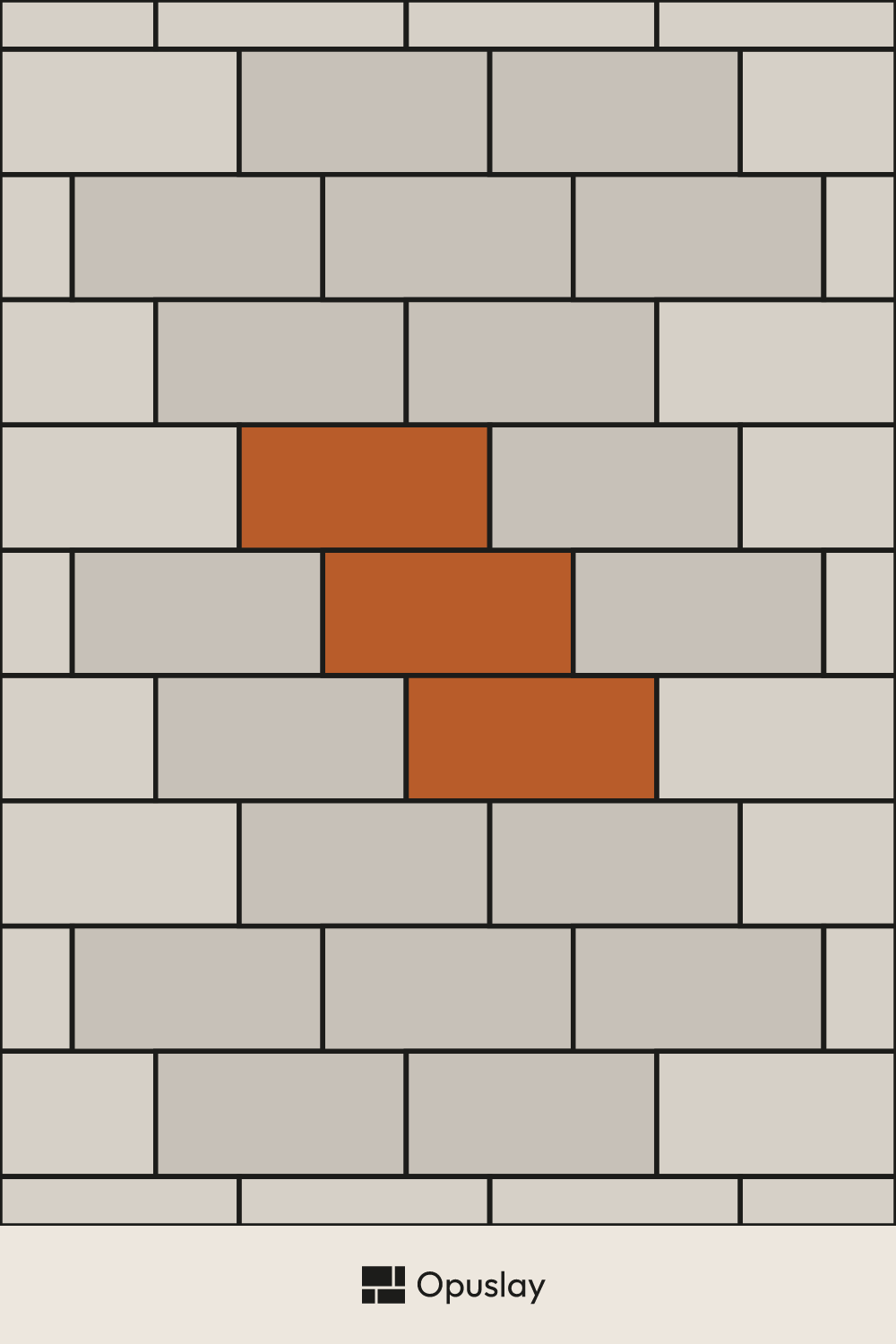
The 300x600 running bond pattern lays one of the most widely sold large-format tile sizes with a 1/3 offset between rows, rather than a traditional 50% half-lap, following manufacturer guidance to limit lippage on a tile this size.
Last updated: 2026-08-06
300x600 1/3 Offset Running Bond
Opuslay — tile layout worksheet- Room:
- 3 m × 2.5 m
- Units:
- Metric (mm / m²)
- Anchor:
- Left · Top
- Layout angle:
- Straight
- Tile colours:
- Single colour
Material breakdown
| Format | Qty / Pattern | Share | Qty / Room | Area / Room |
|---|---|---|---|---|
| 300x600 mm | 3 | 100.0% | 51 | 7.50 m² |
| Total | 3 | 100% | 51 | 7.50 m² |
What you'll need to buy
Tiles to buy
| 300x600 mm | 48 tiles | 8.64 m² |
Total 48 tiles · 8.64 m² (incl. 15% cuts & breakage)
Adhesive & grout
- Thin-set adhesive: ≈ 40.5 kg (3 × 20 kg bags) — recommended trowel: 12mm notch, large format
- Grout — the tile sets the joint width, not you:
- ≈ 1.7 kg (1 × 2.5 kg bag) — 3mm joint, rectified / tight-set tile
- ≈ 2.9 kg (1 × 10 kg bag) — 5mm joint, natural or non-rectified tile
Adhesive: allow a little over on an uneven substrate, or if you back-butter large tiles — both eat more than a flat bed.
Grout: bag sizes vary by brand — 10 kg is a common one (2.5 kg for small jobs). Buy it in one go and stick to a single bag size: bags from different batches can dry to slightly different shades.
It's the tile that decides the joint, not the setter — dry-lay a section to find your width. Assumes 9.5mm tile depth; adjust for your product — thicker tiles need more.
Share & export
Save the 300x600 1/3 Offset Running Bond layout to your moodboard, or send the link to your tiler — it reopens with your room dimensions.

About the 300x600 1/3 Offset Running Bond
300x600 is among the best-selling large-format tile sizes for floors and walls alike, which makes its layout one of the most frequently searched by homeowners and tilers.
Because a 600mm-long tile is well beyond the length at which a 50% overlap starts to risk lippage, a reduced offset — commonly a third or less — is what most manufacturers recommend, and it has become the de facto standard running-bond ratio for this size.
Every 300x600 size on this page is a grid dimension — the tile plus its grout joint. A nominal 300x600 tile is a slightly smaller fired tile set on a 300x600 mm grid, the joint making up the difference; the calculator counts grid cells, which is exactly what you set out on the floor, so the tile count is exact rather than an estimate. Large-format porcelain this size is usually sold rectified — cut to a precise size — so it sits on a tight, even joint (around 3mm).
Frequently Asked Questions
What offset should I use for 300x600 tile?
Most manufacturers recommend a 1/3 offset for 300x600 tile rather than a full 50% offset, to reduce the risk of lippage on a tile this large.
Can 300x600 tile be used on both floors and walls?
Yes — 300x600 is one of the most versatile large-format sizes, sold in floor-rated porcelain as well as lighter wall tile, which is part of why it is such a popular size. The calculator covers both: switch the surface from floor to wall and you can set out up to three walls at once, each with its own width and its own starting point, all sharing the same pattern and the same height.
How much waste should I allow for a 300x600 running bond floor?
You don't have to guess at a flat percentage here. The calculator sets the pattern out across the real dimensions of your room, then counts what each cut actually leaves behind: offcuts long enough to start another row are put back to work, the rest is waste. A 1/3 offset happens to be efficient that way — the piece cut off the end of one row is often what starts the next. What comes back is a figure for your room and your tile size, with a breakage margin on top, rather than a blanket 10%.
Why not use a 50% offset on 300x600 tile?
A 50% offset on a tile this long noticeably increases the risk of visible lippage if the tile has any slight warp, which is why the recommended maximum for large-format tile is closer to a third. The two are easy to tell apart once they are down: at 50% the vertical joints line up again every 2 rows, at 1/3 only every 3 rows — and it is that longer repeat that keeps small differences between tiles from collecting into a visible ridge.
How wide should the grout joint be for 300x600 tile?
Joint width isn't really a free choice — it is set by how much the tiles vary in size (their calibre). Industry practice is a joint at least three times that variation, and never tighter than about 1.5mm. On large-format tile like this the practical minimum is around 3mm for rectified tile and 5mm or more for non-rectified, plus a little extra if the tiles show any warp. Rectified 300x600 usually sits near that 3mm minimum.