
French Pattern Tile
The French pattern — also called the Versailles pattern — is a modular layout built from four tile sizes: 200x200, 200x400, 400x400 and 400x600 mm, laid twelve pieces at a time (four 200x200, two 200x400, four 400x400 and two 400x600) to form a repeating 1200x1200 mm module. It is the classic look for travertine and natural stone, and a mainstay of patios, alfresco areas and pool surrounds as well as indoor floors.
Last updated: 2026-07-12
French pattern
Opuslay — tile layout worksheet- Room:
- 3 m × 2.5 m
- Units:
- Metric (mm / m²)
- Anchor:
- Left · Top
- Layout angle:
- Straight
- Tile colours:
- Single colour
Material breakdown
| Format | Qty / Pattern | Share | Qty / Room | Area / Room |
|---|---|---|---|---|
| 400x400 mm | 4 | 44.4% | 27 | 3.64 m² |
| 400x600 mm | 2 | 33.3% | 13 | 2.22 m² |
| 200x200 mm | 4 | 11.1% | 22 | 0.84 m² |
| 200x400 mm | 2 | 11.1% | 10 | 0.80 m² |
| Total | 12 | 100% | 72 | 7.50 m² |
What you'll need to buy
Tiles to buy
| 200x200 mm | 23 tiles | 0.92 m² |
| 200x400 mm | 11 tiles | 0.88 m² |
| 400x400 mm | 26 tiles | 4.16 m² |
| 400x600 mm | 13 tiles | 3.12 m² |
Total 73 tiles · 9.08 m² (incl. 21% cuts & breakage)
Adhesive & grout
- Thin-set adhesive: ≈ 40.5 kg (3 × 20 kg bags) — recommended trowel: 12mm notch, large format
- Grout — the tile sets the joint width, not you:
- ≈ 1.9 kg (1 × 2.5 kg bag) — 3mm joint, rectified / tight-set tile
- ≈ 3.2 kg (1 × 10 kg bag) — 5mm joint, natural or non-rectified tile
Adhesive: allow a little over on an uneven substrate, or if you back-butter large tiles — both eat more than a flat bed.
Grout: bag sizes vary by brand — 10 kg is a common one (2.5 kg for small jobs). Buy it in one go and stick to a single bag size: bags from different batches can dry to slightly different shades.
It's the tile that decides the joint, not the setter — dry-lay a section to find your width. Assumes 9.5mm tile depth; adjust for your product — thicker tiles need more.
Share & export
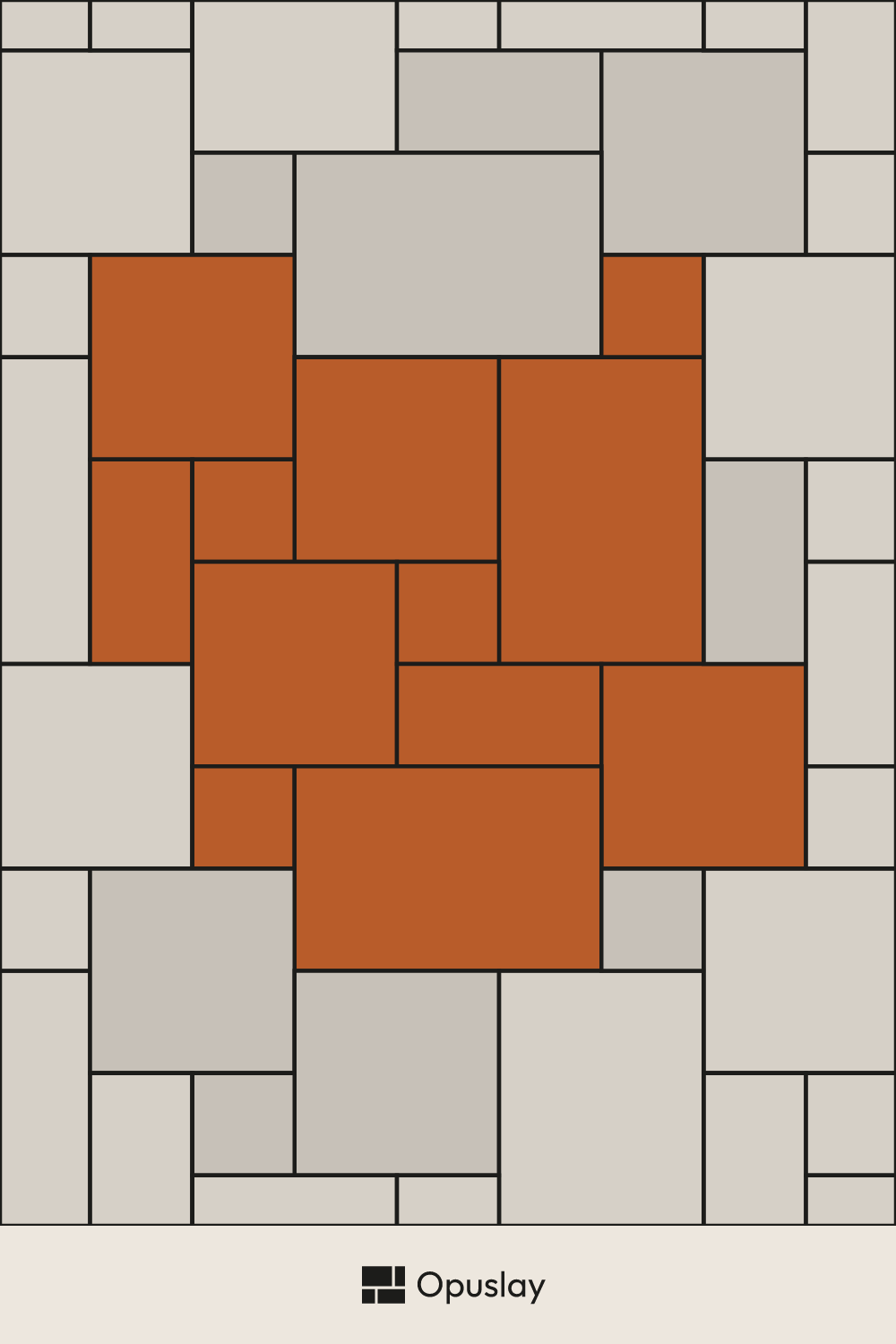
Save the French pattern layout to your moodboard, or send the link to your tiler — it reopens with your room dimensions.

About the French pattern
The name is popularly attributed to the large-format stone floors of the Château de Versailles, though no archival source documents this origin directly. The layout belongs to a much older family of Roman-derived modular arrangements built from a small set of interlocking tile sizes.
In Australia the French pattern is especially popular in travertine for outdoor living — patios, alfresco zones and pool surrounds — and the same four-size module is sold as a ready-made French pattern set in travertine, marble, limestone and, increasingly, porcelain.
Because a French pattern interlocks four sizes, the grout joints do structural work: each nominal size is a grid dimension — the tile plus its joint — and two small tiles plus the joint between them have to add up to one large tile for the module to stay square. The calculator counts these grid cells, so the count is exact. Travertine and natural-stone sets like these are rarely rectified and vary from piece to piece, so a slightly wider joint absorbs that; it is worth measuring the tiles you actually bought before settling on a joint width.
Frequently Asked Questions
Should I use natural stone or ceramic tile for a French pattern?
Both work. The French pattern originated in natural stone — travertine, marble and limestone are the classic choice for patios, alfresco areas and pool surrounds — but the same four-size module is now widely produced in porcelain and ceramic, which is easier to maintain and often more affordable. The layout and the quantities are identical either way, so you can plan your job here and choose the material separately.
Is French pattern the same as Versailles pattern?
Yes — "French pattern" and "Versailles pattern" refer to the same four-size tile layout (200x200, 200x400, 400x400, 400x600 mm) and are used interchangeably by tile suppliers and installers.
What tile sizes make up a French pattern?
The classic French pattern combines four sizes — 200x200, 200x400, 400x400 and 400x600 mm — twelve tiles at a time into a repeating 1200x1200 mm module. Suppliers usually sell the four sizes together as a ready-made French pattern set.
How much waste should I allow for a French pattern?
Most installers allow 10-15% waste for a French pattern — a little more than a single-size layout — to cover the extra cuts needed at room edges across four different tile sizes, and a little more again for a natural-stone job where colour and cut are matched by eye.
How wide should the grout joints be in a French pattern?
A French pattern mixes four sizes that all have to line up, so the joints do more work than in a single-size floor. Travertine and stone sets are rarely rectified and vary from piece to piece, so a joint around 5mm gives that natural variation somewhere to go and keeps the module square — a little wider still suits a rustic outdoor or pool-surround look. Industry practice sets the floor — at least three times the tiles' size variation, never tighter than about 1.5mm — but the multi-size fit is our own point: dry-lay a section and measure your actual tiles first, because a four-size grid is far less forgiving than a plain running bond.
See an alternate metric layout using the same tile sizes (Layout 6)