
Checkerboard Tile Pattern
A checkerboard tile pattern alternates two tile colours across a straight grid so that no two touching tiles share a colour — the classic two-tone floor. This calculator lays it out on a 300 x 300mm grid, the classic size for the look, and counts how many tiles of each colour your room actually needs. It is rarely an even split: the balance shifts with how many tiles fit across and down the room, and with where the grid is anchored — start the pattern from a corner instead of the centre and the same room can call for a different colour majority. The same two-tone treatment works at other square sizes too, and reads just as well laid on the diagonal for an entrance-hall look.
Last updated: 2026-08-05
One-Tile Pattern — 12x12 (Straight/Stack Bond)
Opuslay — tile layout worksheet- Room:
- 3 m × 2.5 m
- Units:
- Metric (mm / m²)
- Anchor:
- Left · Top
- Layout angle:
- Straight
- Tile colours:
- 2 colours
Material breakdown
| Format | Share | Qty / Room | Area / Room |
|---|---|---|---|
| 300x300 mm | 100.0% | 90 | 7.50 m² |
| Color A | 50.0% | 45 | 3.75 m² |
| Color B | 50.0% | 45 | 3.75 m² |
| Total | 100% | 90 | 7.50 m² |
What you'll need to buy
Tiles to buy
| 300x300 mm · Color A | 46 tiles | 4.14 m² |
| 300x300 mm · Color B | 46 tiles | 4.14 m² |
Total 92 tiles · 8.28 m² (incl. 10% cuts & breakage)
Adhesive & grout
- Thin-set adhesive: ≈ 24.4 kg (2 × 20 kg bags) — recommended trowel: 10mm notch
- Grout — the tile sets the joint width, not you:
- ≈ 2.3 kg (1 × 2.5 kg bag) — 3mm joint, rectified / tight-set tile
- ≈ 3.8 kg (1 × 10 kg bag) — 5mm joint, natural or non-rectified tile
Adhesive: allow a little over on an uneven substrate, or if you back-butter large tiles — both eat more than a flat bed.
Grout: bag sizes vary by brand — 10 kg is a common one (2.5 kg for small jobs). Buy it in one go and stick to a single bag size: bags from different batches can dry to slightly different shades.
It's the tile that decides the joint, not the setter — dry-lay a section to find your width. Assumes 9.5mm tile depth; adjust for your product — thicker tiles need more.
Share & export
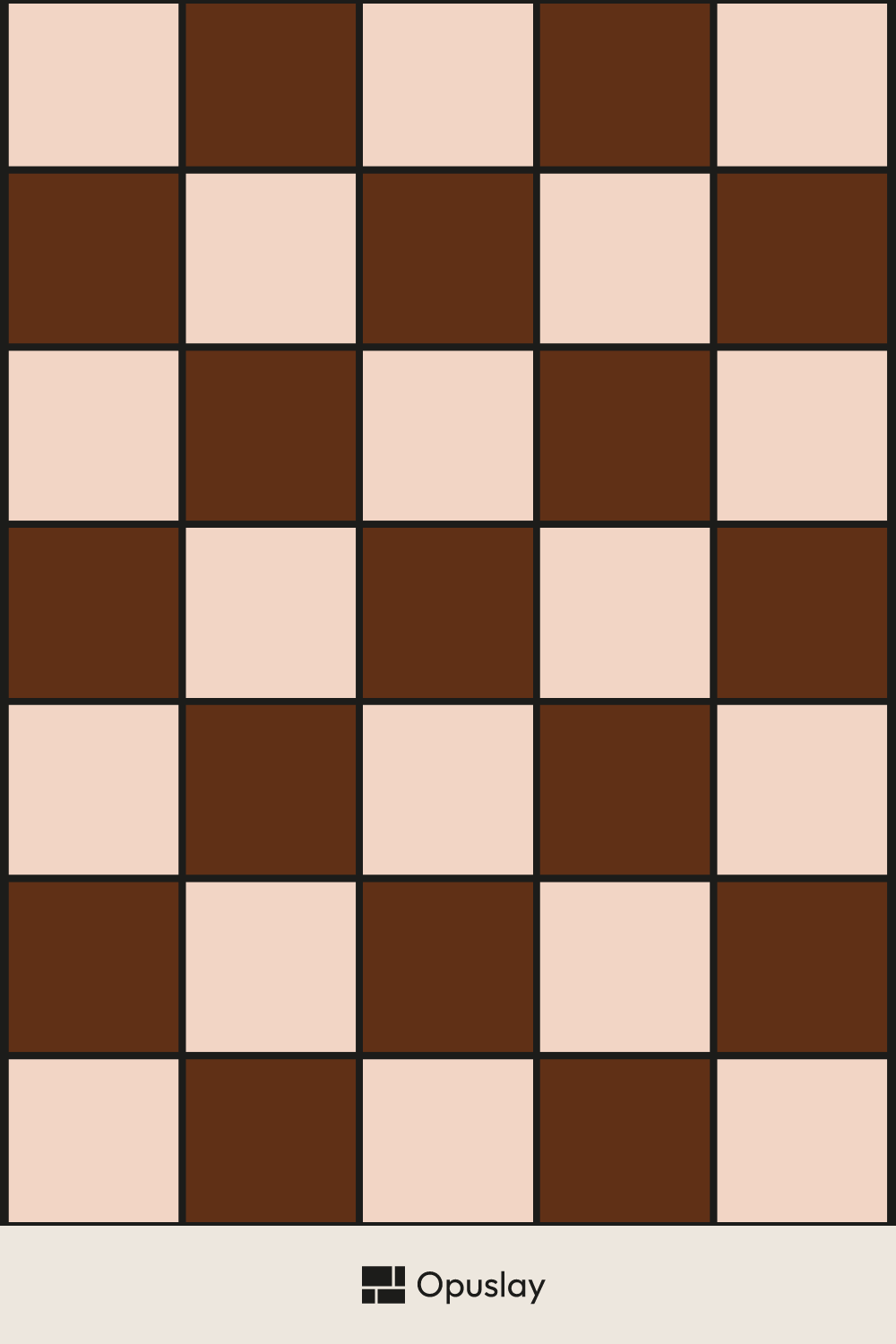
Save the One-Tile Pattern — 12x12 (Straight/Stack Bond) layout to your moodboard, or send the link to your tiler — it reopens with your room dimensions.

About the Checkerboard Tile Pattern
Alternating two contrasting tile colours across a straight grid is one of the oldest tricks in flooring — a simple two-colour rule that reads clearly at any tile size, long used in halls, porches and kitchens well before any particular material or era claimed it as a signature look. What has changed is less the pattern than the range of sizes and colour pairs it is now applied to, from small mosaic-scale tiles up to large-format squares.
Frequently Asked Questions
How many tiles of each colour do I need for a checkerboard floor?
It's rarely a 50/50 split. The exact count of each colour depends on how many tiles fit across and down your room and where the layout is anchored — an odd number of tiles in either direction tips the balance toward one colour. The calculator splits the total by colour for your exact room.
What size tile is best for a checkerboard pattern?
Square tiles give the cleanest checkerboard, since every tile meets its neighbours on equal edges. 300 x 300mm is the classic choice for this look, but the same alternation works just as well at other square sizes for a more contemporary, large-format result.
Can any tile layout be made into a checkerboard?
Only layouts where tiles meet in a clean grid alternate cleanly into two colours. A running-bond (offset) layout puts some same-colour tiles edge to edge, so it reads as a two-tone brick rather than a true checkerboard. You can still apply two, three or four colours to any grid layout in the calculator and judge the result yourself.
Can a checkerboard floor be laid on the diagonal?
Yes — turning the same two-colour grid 45 degrees is a classic entrance-hall treatment. The colour count works the same way; only the cut pieces along the edges change, since a diagonal layout always needs corner triangles.
Is checkerboard the same as chequerboard tile?
Yes, chequerboard is simply an alternative spelling of the same two-colour grid pattern — checkerboard is the term most commonly searched and used across the trade.