
Penny Tile Pattern
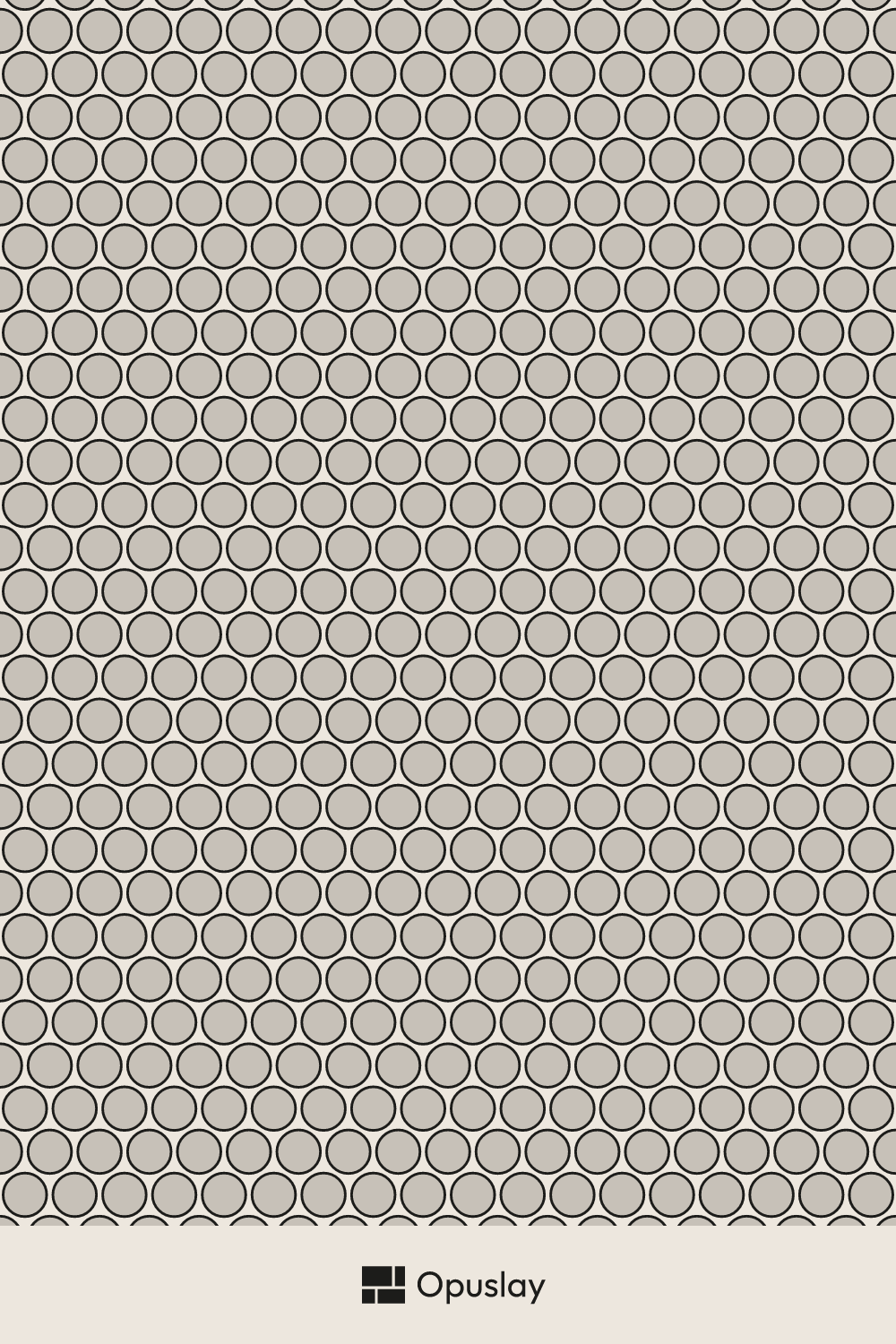
The penny tile pattern — also called penny round — arranges small round tiles, each about 3/4 inch across, in staggered rows offset by half a tile from one row to the next. This offset, or quincunx, arrangement is the classic penny round layout on most mesh-mounted sheets: it packs the circles more tightly than a straight grid and keeps the grout joint narrow and even across the field. Opuslay models the tiles on the standard 12-inch sheet, the same footprint as a single 12x12 tile, and counts the sheets and cuts your room needs.
Last updated: 2026-07-18
Penny Tile Pattern
Opuslay — tile layout worksheet- Room:
- 3 m × 2.5 m
- Units:
- Metric (cm / m²)
- Anchor:
- Left · Top
- Layout angle:
- Straight
- Tile colours:
- Single colour
Material breakdown
| Format | Qty / Pattern | Share | Qty / Room | Area / Room |
|---|---|---|---|---|
| 30x30 cm | 1 | 100.0% | 90 | 7.50 m² |
| Total | 1 | 100% | 90 | 7.50 m² |
What you'll need to buy
Sheets to buy
| 30x30 cm | 90 sheets | 8.10 m² |
Total 90 sheets · 8.10 m² (incl. 8% cuts & breakage)
Adhesive & grout
- Thin-set adhesive: ≈ 19.1 kg (1 × 50 lb bag) — recommended trowel: 5mm V notch
- Grout — mosaic sheets use far more than flat tile:
- ≈ 22.0 kg (2 × 25 lb bags) — dense mosaic joint network
Adhesive: allow a little over on an uneven substrate, or if you back-butter large tiles — both eat more than a flat bed.
Grout: the 25 lb bag is the usual size (10 lb for small jobs). Buy it in one go and stick to a single bag size: bags from different batches can dry to slightly different shades.
About 31% of the surface is joint, set by the sheet mesh — the calculator sizes grout for that dense network, not a flat-tile rate. Assumes 6mm tile depth; thicker tiles need more.
Share & export
Save the Penny Tile Pattern layout to your moodboard, or send the link to your tiler — it reopens with your room dimensions.

About the Penny Tile Pattern
Penny round tiles take their name from their resemblance to the small coin, a comparison that became common in the United States in the early twentieth century as tiny round mosaics gained popularity for bathroom and kitchen floors. Porcelain penny rounds — often unglazed, in white with a black border or a scattered accent color — became a signature of American homes from the 1920s through the 1950s, valued for their slip resistance and the way their many joints let a floor shed water toward a drain.
The staggered, offset arrangement modeled here isn't a modern take on the look — it is the look: nearly every historic penny floor and nearly every penny sheet sold today offsets each row to pack the circles as densely as possible, rather than lining them up in a straight grid.
Frequently Asked Questions
What size are penny round tiles?
Penny round tiles are most commonly 3/4 inch (about 19 mm) across, pre-mounted on 12-inch by 12-inch mesh-backed sheets.
How many penny tile sheets will I need?
That depends on your room, not a rule of thumb. Opuslay lays the 12-inch sheets out against your actual room and counts whole sheets plus the cuts at each edge, so the total already includes the trimming waste — and you shop by the sheet, the way penny tile is sold.
Do penny tiles use more grout than regular tile?
Yes — noticeably more. A penny mosaic has a dense network of joints running between every small circle, so a far larger share of the surface is grout than on flat field tile. Opuslay's estimate accounts for that dense joint network rather than treating the sheet as one large tile, but always check your grout manufacturer's coverage chart for small-format mosaic before you order.
Why are penny tiles staggered instead of set in a straight grid?
Offsetting each row by half a tile lets the circles pack more closely, keeping the grout joint narrow and even. This staggered layout is how penny tile has traditionally been arranged and installed, on both vintage floors and modern mesh-mounted sheets. A straight aligned grid exists as a secondary option, but the offset is the classic look.
Are penny tiles only used on floors?
No. Penny rounds work on both floors and walls, and are especially popular for bathroom floors, shower floors and kitchen backsplashes — the high ratio of grout to tile gives good grip underfoot, which is why they show up so often in wet areas.
Do penny tiles come pre-mounted on sheets?
Yes. Most penny round tile is sold on 12-inch mesh-backed sheets with the circles already arranged in the staggered pattern, so installers set whole sheets rather than placing each tile by hand.