
8x9 Hexagon Tile Pattern
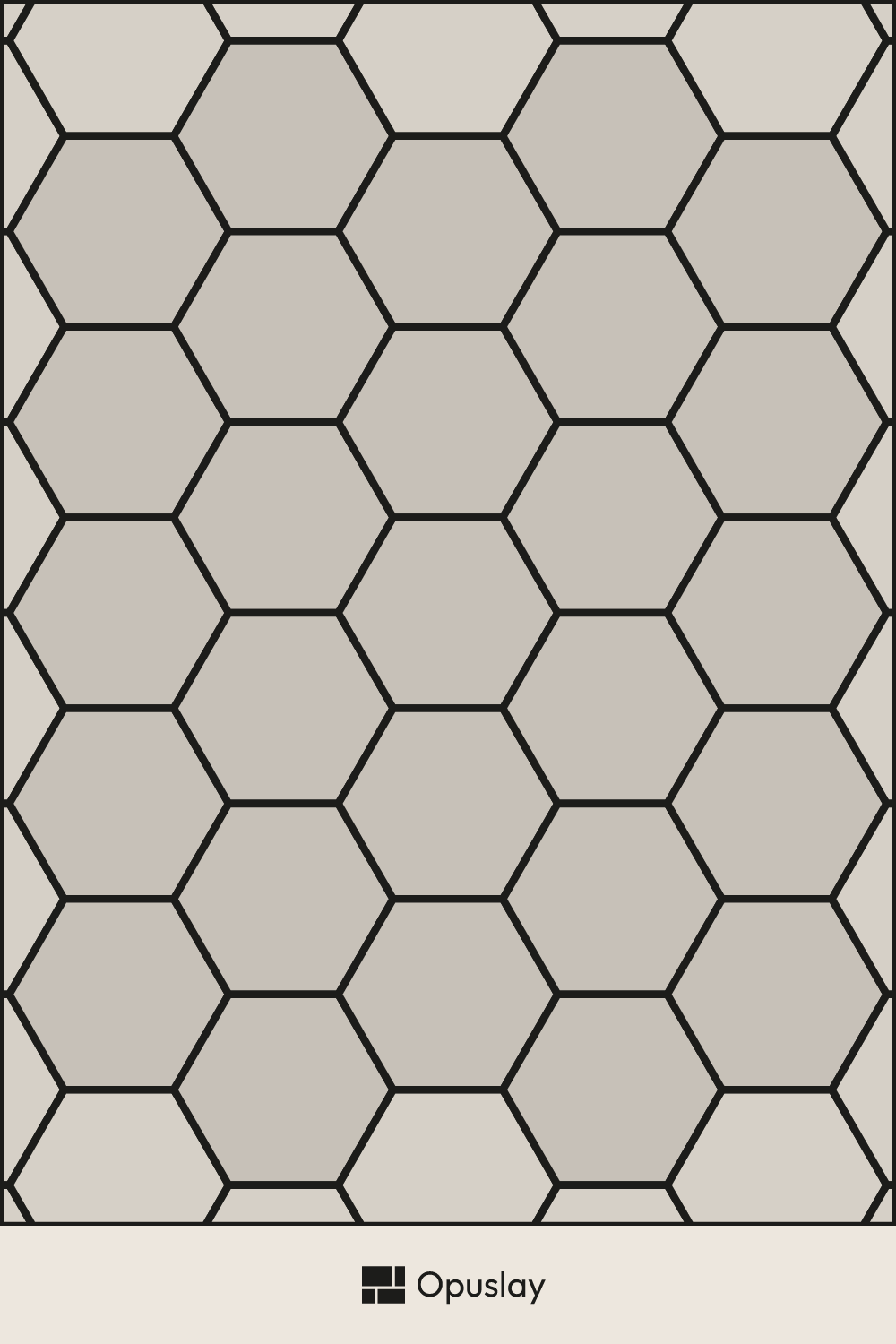
A hexagon tile locks against six neighbors on every side, so no grout line runs straight across the floor — the surface reads as one continuous honeycomb instead of a grid. The size behind this page is the regular hexagon sold as 8x9 nominal (200 x 230 mm, point-to-point by flat-to-flat), set in rows offset by half a tile width. Opuslay lays that grid tile by tile against your room's real dimensions rather than adding a flat waste percentage, so the piece count you get already reflects the honeycomb's six-sided geometry, not a rectangle's. It's a common choice for bathroom floors, entryways and kitchen backsplashes, anywhere an unbroken pattern reads well at a distance.
Last updated: 2026-08-11
Hexagon Pattern
Opuslay — tile layout worksheet- Room:
- 3 m × 2.5 m
- Units:
- Metric (cm / m²)
- Anchor:
- Left · Top
- Layout angle:
- Straight
- Tile colours:
- Single colour
Material breakdown
| Format | Qty / Pattern | Share | Qty / Room | Area / Room |
|---|---|---|---|---|
| 20x23 cm | 1 | 100.0% | 247 | 7.50 m² |
| Total | 1 | 100% | 247 | 7.50 m² |
What you'll need to buy
Tiles to buy
| 20x23 cm | 260 tiles | 11.96 m² |
Total 260 tiles · 8.97 m² (incl. 20% cuts & breakage)
Adhesive & grout
- Thin-set adhesive: ≈ 24.4 kg (2 × 50 lb bags) — recommended trowel: 10mm notch
- Grout — the tile sets the joint width, not you:
- ≈ 3.2 kg (1 × 10 lb bag) — 3mm joint, rectified / tight-set tile
- ≈ 5.3 kg (1 × 25 lb bag) — 5mm joint, natural or non-rectified tile
Adhesive: allow a little over on an uneven substrate, or if you back-butter large tiles — both eat more than a flat bed.
Grout: the 25 lb bag is the usual size (10 lb for small jobs). Buy it in one go and stick to a single bag size: bags from different batches can dry to slightly different shades.
It's the tile that decides the joint, not the setter — dry-lay a section to find your width. Assumes 9.5mm tile depth; adjust for your product — thicker tiles need more.
Share & export
Save the Hexagon Pattern layout to your moodboard, or send the link to your tiler — it reopens with your room dimensions.

About the Hexagon Pattern
The pattern is built from offset rows: each row shifts sideways by half a tile width, so a point on one hexagon nests against the flat side of two tiles in the row above. That offset gives every interior tile six neighbors and keeps any single grout line from crossing the room in a straight run — a joint that starts at one point always ends against a flat edge a few centimeters over, never lining up with the joint three tiles down. It's the same offset logic as a running-bond brick pattern, applied on six sides instead of two, which is why a hexagon floor reads denser than a square grid at the same tile size.
That six-sided geometry has a consequence at the wall: no edge of a hexagon lines up square with a rectangular room, so every tile touching the perimeter needs an angled cut, not the straight trim a square or plank tile gets. Opuslay works out those cuts from your room's actual shape, tile by tile, instead of applying a flat waste percentage on top of the area, so the piece count already includes the partial hexagons the perimeter will consume. If the shape appeals but a full hexagon feels busy for the space, the picket pattern uses the same six-sided module stretched into an elongated hexagon, which lays with far fewer angled cuts along a straight wall.
Frequently Asked Questions
How do I cut hexagon tile at the wall?
Every tile that meets a straight wall needs an angled cut, since none of the hexagon's six edges runs parallel to all four sides of a room at once. A wet saw with a fresh diamond blade handles the angle cleanly; mark each cut from a dry layout first rather than cutting on the fly, since the angle changes slightly depending on where the row lands against the wall.
Is hexagon tile harder to lay than square tile?
Yes, mainly at the edges. The field — the interior tiles that touch six full neighbors — lays about as fast as any offset pattern. What takes longer is the perimeter: every wall, corner and fixture cut is an angle instead of a straight trim, so budget more time for layout and cutting than a square tile job of the same size.
What size hexagon tile should I use in a small bathroom?
The 8x9 (200 x 230 mm) size on this page reads as a mid-size hexagon — big enough that a small bathroom floor doesn't disappear into grout lines, small enough to still turn a corner around a toilet base or drain without excessive cutting. Smaller hexagon mosaics exist for showers and niches, but they're a different product with their own layout.