
Pinwheel / Hopscotch Tile Pattern Calculator
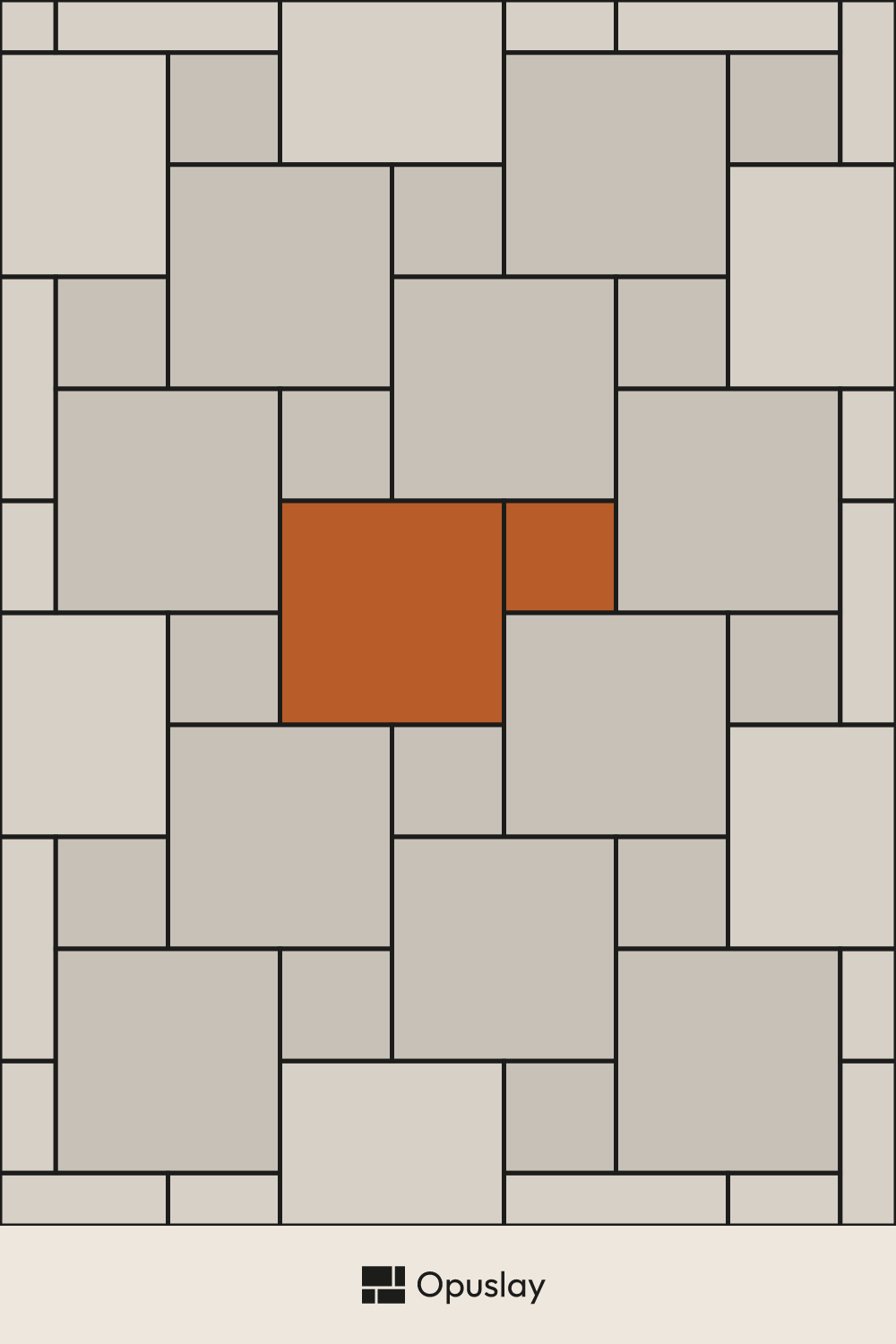
The pinwheel tile pattern — also called hopscotch — sets a large square tile with a small square tucked at each corner, so the joints around the large tiles read as the turning blades of a pinwheel and the small tile reads as its hub. The most common pairing in the US is a 12"x12" field tile with a 6"x6" accent, usually in a contrasting color or material to make the turn visible. Counted by the piece, the two sizes come in equal numbers: one 6x6 for every 12x12.
Last updated: 2026-07-16
Pinwheel
Opuslay — tile layout worksheet- Room:
- 3 m × 2.5 m
- Units:
- Metric (cm / m²)
- Anchor:
- Left · Top
- Layout angle:
- Straight
- Tile colours:
- Single colour
Material breakdown
| Format | Qty / Pattern | Share | Qty / Room | Area / Room |
|---|---|---|---|---|
| 30x30 cm | 1 | 80.0% | 75 | 6.00 m² |
| 15x15 cm | 1 | 20.0% | 68 | 1.50 m² |
| Total | 2 | 100% | 143 | 7.50 m² |
What you'll need to buy
Tiles to buy
| 15x15 cm | 72 tiles | 1.62 m² |
| 30x30 cm | 72 tiles | 6.48 m² |
Total 144 tiles · 8.10 m² (incl. 8% cuts & breakage)
- Thin-set adhesive: ≈ 2 bags (22.7 kg) — recommended trowel: 10mm notch
- Grout — the tile sets the joint width, not you:
- ≈ 1 bag (11.3 kg) — 3mm joint, rectified / tight-set tile
- ≈ 1 bag (11.3 kg) — 5mm joint, natural or non-rectified tile
It's the tile that decides the joint, not the setter — dry-lay a section to find your width. Assumes 9.5mm tile depth; adjust for your product.
Share & export
Save the Pinwheel layout to your moodboard, or send the link to your tiler — it reopens with your room dimensions.
About the Pinwheel / Hopscotch Pattern
Pinwheel and hopscotch are two names for the same layout, and the trade treats them as interchangeable — installers will title a job thread hopscotch/pinwheel without bothering to pick one. A few regional names circulate for the same thing, step-up and four corner among them. What none of these names covers is a module built from rectangles rather than squares; that one is the windmill, and the two get swapped often enough in tile guides to be worth separating.
The small square only has to fill the gap that the offset large tiles leave behind, so the layout is not tied to a 2:1 ratio — any two square sizes will tessellate. A 16x16 & 8x8 pairing keeps the same clean doubling at a larger scale, while a 16x16 & 6x6 pairing shrinks the accent against the field until the small tile reads as punctuation rather than as a component. Installers do lean toward whole-number ratios in practice: pairs like 12 and 6 or 16 and 8 are described as reading deliberate, while mismatched pairs like 16 and 12 draw complaints about looking busy.
Frequently Asked Questions
Is a pinwheel pattern the same as hopscotch?
Yes. Pinwheel and hopscotch describe the same layout — a large square with a smaller square at each corner — and suppliers, installers and manufacturers use both names interchangeably. There is no geometric difference between them, so a quote for one is a quote for the other.
What is the difference between a pinwheel and a windmill pattern?
A pinwheel is all squares. A windmill turns four rectangles around a central square instead. They read as cousins from across a room because both spin around a center, but they take different tiles, so it is worth confirming which one you mean before the order goes in.
How many 6x6 tiles do I need for a 12x12 pinwheel?
One 6x6 for every 12x12 — the two sizes come in equal numbers. That catches people out when they order by the square foot, because by area the split is 80% 12x12 and 20% 6x6 on nominal sizes: a 12x12 covers four times what a 6x6 covers, so equal piece counts are nothing like equal coverage. Order by the piece.
What grout joint should I use for a pinwheel pattern?
For the grid to stay true, two small tiles plus one joint have to add up to one large tile. Nominal sizes make that look automatic — 6 and 6 make 12 — but nominal sizes are rounded and real dimensions vary from one product to the next, so measure the tiles you actually bought before you commit to a joint width.
Why does my pinwheel pattern walk?
Because the arithmetic above is slightly off: the joints stay parallel but stop lining up, drifting a little further with every course. Installers who have run large pinwheel floors treat the walk as manageable rather than fatal — snap reference lines, measure back to them as you go, and work out early which way the drift runs so you do not reach the far wall with a wide gap to hide.
How much waste should I allow for a pinwheel pattern?
Around 10% is a reasonable starting point, but a flat percentage is a weak proxy here: the cuts depend on where the grid starts and on which of the two sizes lands against each wall. Opuslay lays the module out tile by tile against your actual room and counts the cuts it finds, in pieces of each size.