
Windmill Tile Pattern Calculator
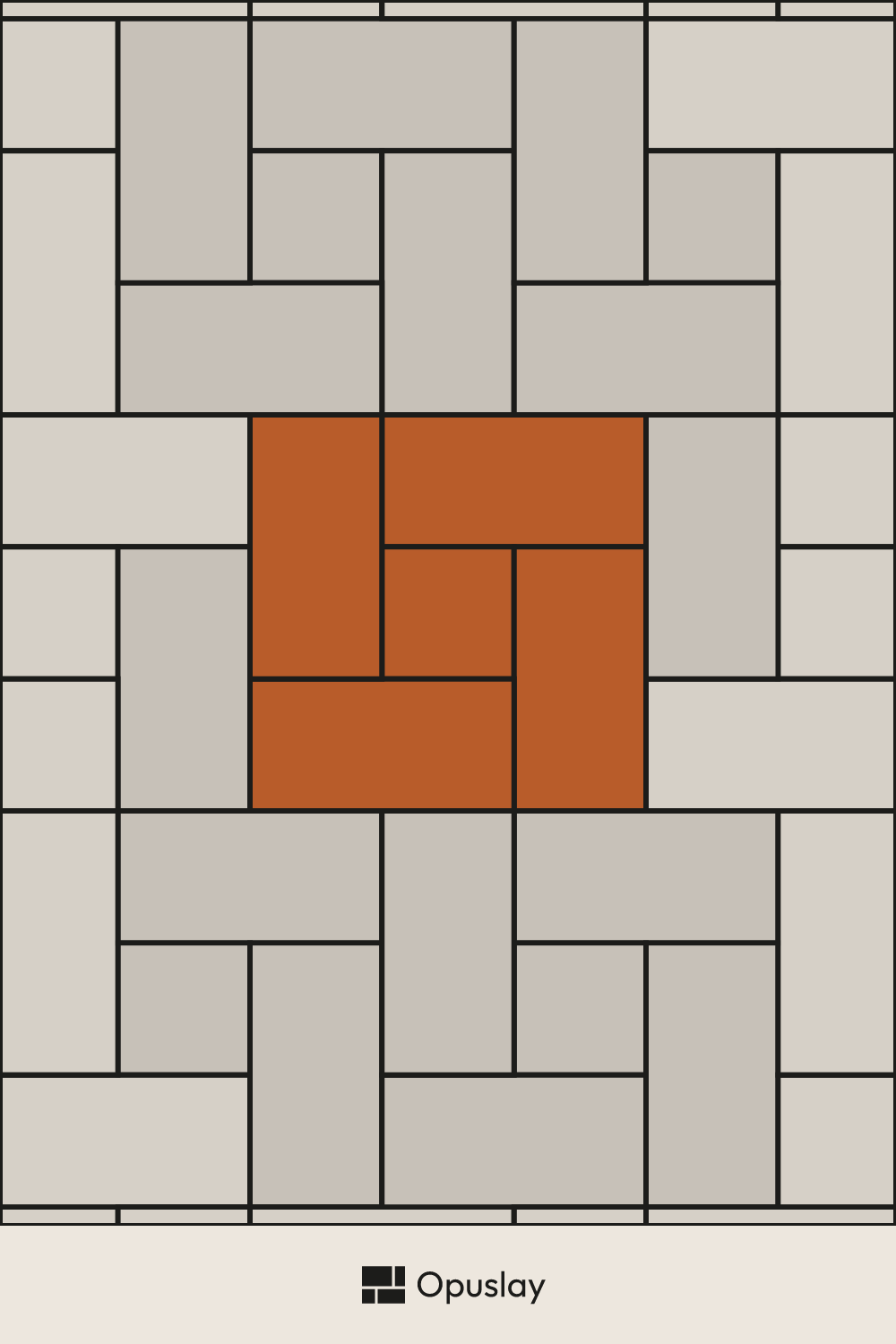
The windmill tile pattern turns four rectangles around a single small square, each rectangle set at a right angle to the next so the four of them close around the square at the hub. The standard pairing is four 6"x12" rectangles and one 6"x6" square, giving a module that closes as a perfect 18"x18" block — 2.25 square feet per turn, with the square often carrying an accent color so that it reads as the axle. Because the module is a true square, the field carries a straight joint every 18 inches in both directions: each turn reads as a framed unit rather than dissolving into the floor.
Last updated: 2026-07-16
Windmill
Opuslay — tile layout worksheet- Room:
- 3 m × 2.5 m
- Units:
- Metric (cm / m²)
- Anchor:
- Left · Top
- Layout angle:
- Straight
- Tile colours:
- Single colour
Material breakdown
| Format | Qty / Pattern | Share | Qty / Room | Area / Room |
|---|---|---|---|---|
| 15x30 cm | 4 | 88.9% | 157 | 6.65 m² |
| 15x15 cm | 1 | 11.1% | 40 | 0.85 m² |
| Total | 5 | 100% | 197 | 7.50 m² |
What you'll need to buy
Tiles to buy
| 15x15 cm | 42 tiles | 0.94 m² |
| 15x30 cm | 159 tiles | 7.16 m² |
Total 201 tiles · 8.10 m² (incl. 8% cuts & breakage)
- Thin-set adhesive: ≈ 2 bags (22.7 kg) — recommended trowel: 10mm notch
- Grout — the tile sets the joint width, not you:
- ≈ 1 bag (11.3 kg) — 3mm joint, rectified / tight-set tile
- ≈ 1 bag (11.3 kg) — 5mm joint, natural or non-rectified tile
It's the tile that decides the joint, not the setter — dry-lay a section to find your width. Assumes 9.5mm tile depth; adjust for your product.
Share & export
Save the Windmill layout to your moodboard, or send the link to your tiler — it reopens with your room dimensions.
About the Windmill Pattern
The windmill is not a free-form layout: the four rectangles only close around the square when the square's side equals the difference between the rectangle's length and its width. A 6x12 rectangle gives 12 minus 6, so a 6x6 square — which is why that pairing is the one the trade means by windmill. You will also see the rule stated as the rectangle runs double the square, and on a 6x12 the two statements happen to agree. They part company on other rectangles, and the difference rule is the one that holds.
The pattern shares both its formats with the cobblestone pattern — the same 6x6 square and 6x12 rectangle — but assembles them into a different module: the windmill closes four rectangles around one square across an 18x18 repeat, while cobblestone interlocks four squares and six rectangles across a 24x24 one. If you have already priced tile for one, the same two sizes cover the other.
Frequently Asked Questions
Is a windmill pattern the same as a pinwheel?
No, though the names get swapped constantly. A pinwheel — also called hopscotch — uses two square tiles, a large one with a small one at each corner. A windmill uses four rectangles around a central square. Different modules, different tile lists, so confirm which one you mean before ordering.
What tile sizes do I need for a windmill pattern?
Four rectangles and one square per module, with the square's side equal to the rectangle's length minus its width. A 6x12 rectangle pairs with a 6x6 square and closes at 18x18. Change the rectangle and the square follows: a 4x12 rectangle wants an 8x8 square, closing at 16x16 — a module the usual shorthand would reject, since 12 is not double 8, yet it tessellates exactly. Get the difference wrong and the four rectangles will not close.
How many tiles of each size does a windmill pattern use?
Four rectangles to every one square. By area the split is roughly 89% rectangle and 11% square on nominal sizes, so the square is an accent in coverage terms even though it sits at the visual center of every turn.
How much waste should I allow for a windmill pattern?
Around 10% is a sensible starting point, though the module's hard 18x18 grid makes the starting point matter more here than on a layout with broken joints: move the anchor and every cut at every wall moves with it. Opuslay lays the module against your actual room from the anchor you choose and counts the cuts it finds, in pieces of each size.