
Basketweave Tile Pattern
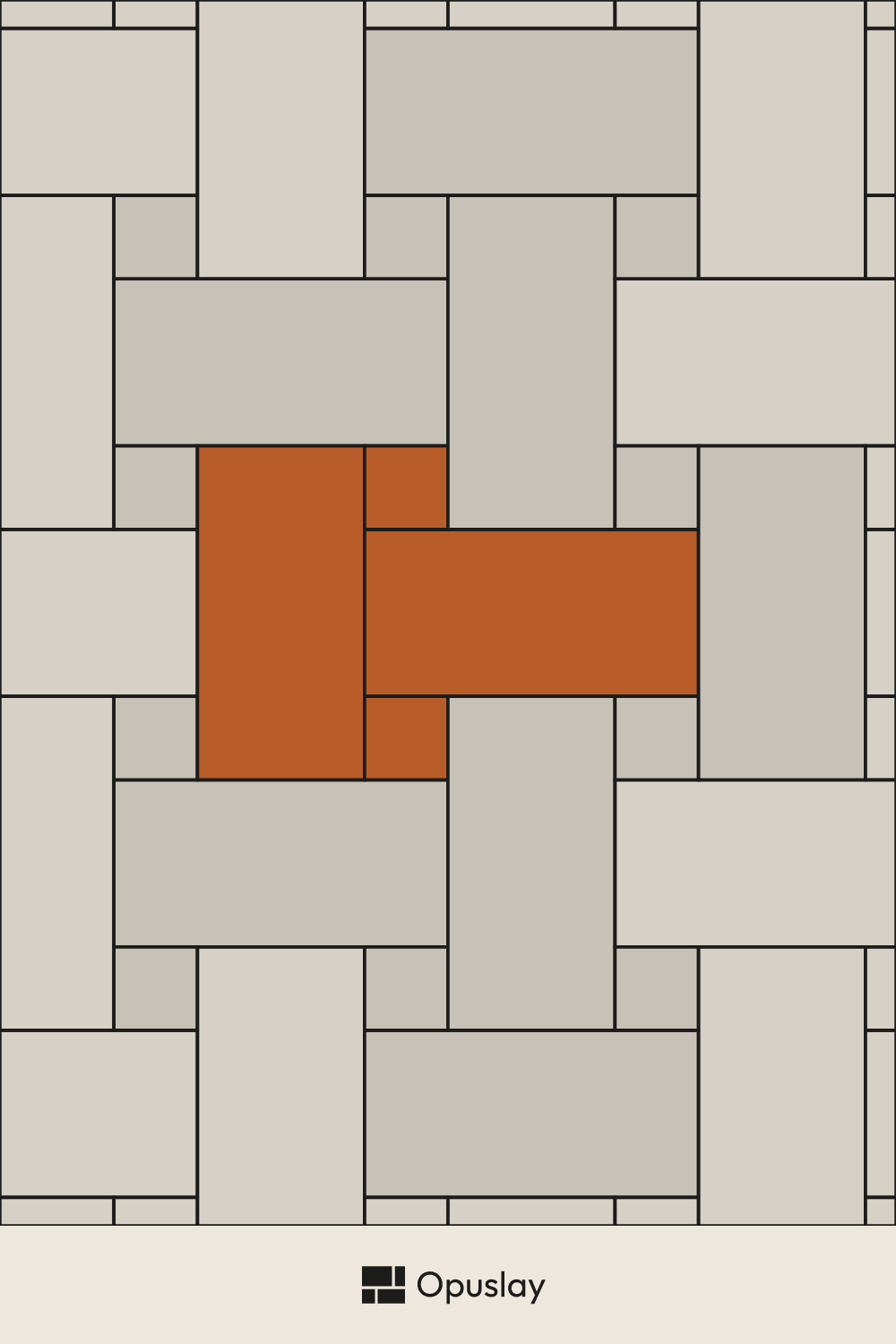
The basketweave tile pattern weaves rectangular planks in alternating horizontal and vertical pairs, so the surface reads like the over-under strands of a woven basket. This calculator draws a cabochon variant: a 12"x24" plank set against a neighbour turned 90°, with small 6"x6" square dots — the cabochons — tucked into the corners. One repeating unit is built from two interlocking planks and two cabochon squares, staggered on a diagonal so no grout line runs straight across the floor.
Last updated: 2026-07-12
Basketweave
Opuslay — tile layout worksheet- Room:
- 3 m × 2.5 m
- Units:
- Metric (cm / m²)
- Anchor:
- Left · Top
- Layout angle:
- Straight
- Tile colours:
- Single colour
Material breakdown
| Format | Qty / Pattern | Share | Qty / Room | Area / Room |
|---|---|---|---|---|
| 30x60 cm | 2 | 88.9% | 45 | 6.69 m² |
| 15x15 cm | 2 | 11.1% | 36 | 0.81 m² |
| Total | 4 | 100% | 81 | 7.50 m² |
What you'll need to buy
Tiles to buy
| 15x15 cm | 38 tiles | 0.85 m² |
| 30x60 cm | 45 tiles | 8.10 m² |
Total 83 tiles · 8.96 m² (incl. 19% cuts & breakage)
- Thin-set adhesive: ≈ 3 bags (22.7 kg) — recommended trowel: 12mm notch, large format
- Grout — the tile sets the joint width, not you:
- ≈ 1 bag (11.3 kg) — 3mm joint, rectified / tight-set tile
- ≈ 1 bag (11.3 kg) — 5mm joint, natural or non-rectified tile
It's the tile that decides the joint, not the setter — dry-lay a section to find your width. Assumes 9.5mm tile depth; adjust for your product.
Share & export
Save the Basketweave layout to your moodboard, or send the link to your tiler — it reopens with your room dimensions.
About the Basketweave pattern
The over-under weave is one of the oldest decorative layouts in stone, brick and parquet, and it scales freely: the same plank-and-cabochon unit reads as a fine mosaic in small formats or as a bold, graphic floor in large-format planks like the 12x24 used here. Drop the cabochon dots and the same plank weaves as a single-size 12x24 basketweave.
Basketweave is a close cousin of the cobblestone pattern — both interlock two sizes so the joints break across the room — but the basketweave keeps its rectangles in matched pairs to build the woven rhythm, rather than a 1:2 brick interlock. Some suppliers sell the planks and dots together as a basketweave set in marble, porcelain or natural stone, though the exact naming varies by brand. The same cabochon module scales down to a 4x8 basketweave and the classic 2x4 marble weave.
Each size here is a grid dimension — the tile plus its grout joint — and the woven pairs only line up if the joints are right: it isn't the setter who picks the joint width, the tile does. The calculator counts these grid cells, so the count is exact. Marble and stone basketweave sets are rarely rectified and vary from piece to piece, so a dry-lay (loose, without adhesive) is the way to find the joint width that keeps the weave square before you commit.
Frequently Asked Questions
What tile sizes make a basketweave pattern?
Traditionally two rectangles woven in matched pairs, often with a small square dot (a cabochon) between them. In this calculator the repeating unit uses 12x24 planks with 6x6 cabochon squares; classic small-format basketweave uses sizes such as 2x4 rectangles with 1x1 dots.
How much waste should I add for a basketweave pattern?
Around 10% is a sensible starting point. Opuslay lays the module out tile by tile against your actual room, so the estimate reflects the real cuts at the walls rather than a flat percentage.
Is a basketweave the same as a cobblestone pattern?
No. A basketweave weaves rectangles in matched over-under pairs, while a cobblestone pattern interlocks a single square with a double-length rectangle in a 1:2 ratio. Both stagger their joints, but the basketweave keeps the woven look.
Does the basketweave pattern work on walls?
Yes — basketweave is a popular backsplash and feature-wall layout as well as a floor or patio. The woven rhythm reads well at eye level, and the cabochon dots add a decorative accent behind a range or vanity.
How wide should the grout joints be in a basketweave pattern?
It isn't really the setter's choice — it's the tile's. A basketweave only reads as a clean weave if two planks plus their joints match the length they're woven against, and marble or stone sets vary from piece to piece, so a dry-lay without adhesive is the reliable way to find the right joint before you fix anything. ANSI A108.02 §4.3.8 sets the floor — at least three times the tiles' size variation, never under 1/16", and for the 12x24 planks (over 15" on a side) a 1/8"–3/16" minimum — but the woven fit is our own point: measure your actual tiles first.