
Cobblestone Tile Pattern
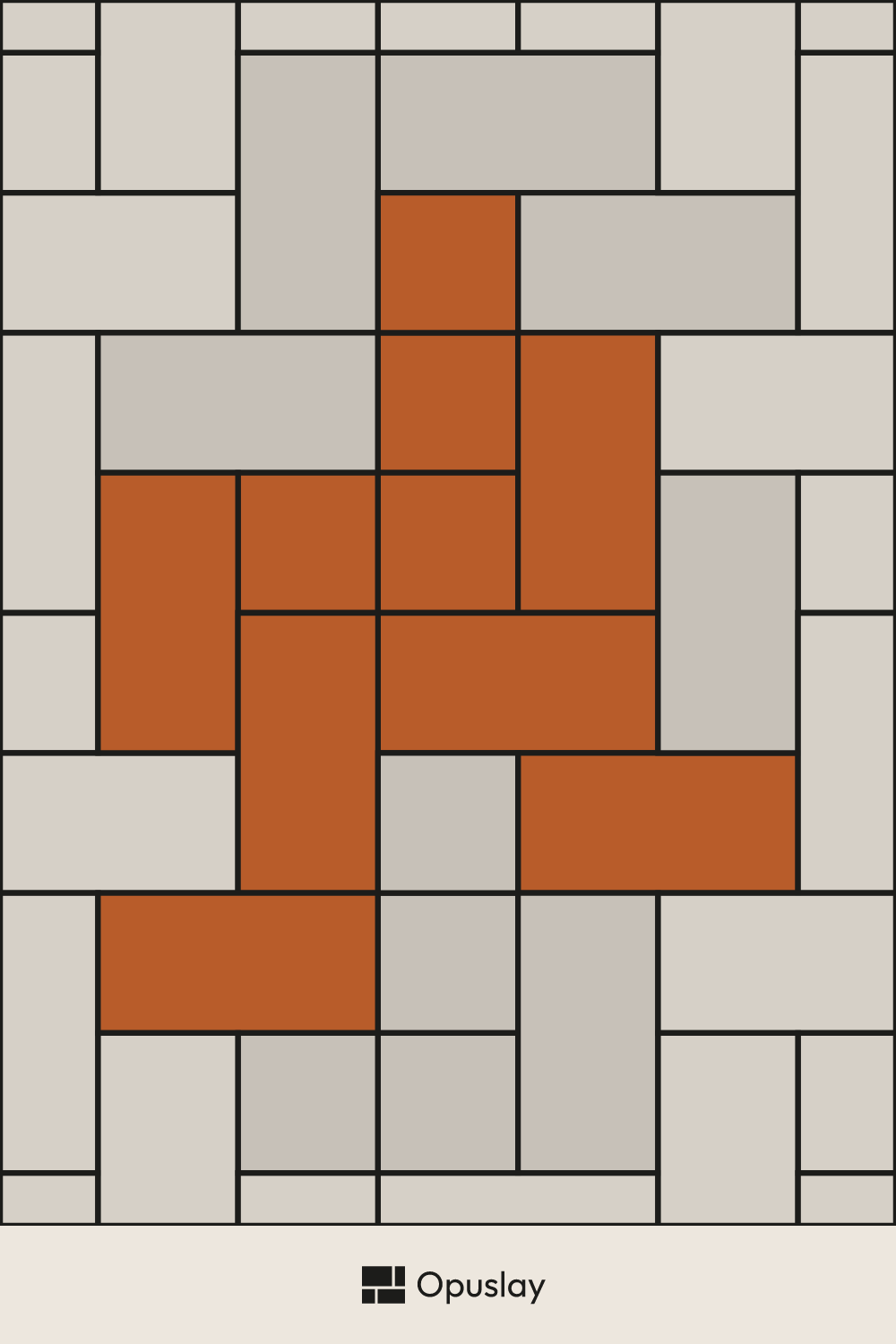
The cobblestone tile pattern is a two-size modular layout that pairs a 6"x6" square with a 6"x12" rectangle in a 1:2 ratio, set in rotating orientations to evoke the irregular, hand-set look of old-world cobblestone paving. One repeating unit spans 24"x24" and is built from four 6x6 squares and six 6x12 rectangles that interlock so no grout line runs straight across the floor.
Last updated: 2026-07-12
Cobblestone
Opuslay — tile layout worksheet- Room:
- 3 m × 2.5 m
- Units:
- Metric (cm / m²)
- Anchor:
- Left · Top
- Layout angle:
- Straight
- Tile colours:
- Single colour
Material breakdown
| Format | Qty / Pattern | Share | Qty / Room | Area / Room |
|---|---|---|---|---|
| 15x15 cm | 4 | 25.0% | 85 | 1.88 m² |
| 15x30 cm | 6 | 75.0% | 135 | 5.63 m² |
| Total | 10 | 100% | 220 | 7.50 m² |
What you'll need to buy
Tiles to buy
| 15x15 cm | 90 tiles | 2.02 m² |
| 15x30 cm | 136 tiles | 6.12 m² |
Total 226 tiles · 8.14 m² (incl. 9% cuts & breakage)
- Thin-set adhesive: ≈ 2 bags (22.7 kg) — recommended trowel: 10mm notch
- Grout — the tile sets the joint width, not you:
- ≈ 1 bag (11.3 kg) — 3mm joint, rectified / tight-set tile
- ≈ 1 bag (11.3 kg) — 5mm joint, natural or non-rectified tile
It's the tile that decides the joint, not the setter — dry-lay a section to find your width. Assumes 9.5mm tile depth; adjust for your product.
Share & export
Save the Cobblestone layout to your moodboard, or send the link to your tiler — it reopens with your room dimensions.
About the Cobblestone pattern
Because the square and the rectangle share the same 6-inch base dimension, the module tessellates cleanly at any scale: the same square-plus-double-rectangle arrangement reads as a tight, mosaic-like floor in 2x2 & 2x4 tiles.
Step the same module up and it becomes a bolder, more open floor in 4x4 & 4x8 tiles. Some suppliers sell the two sizes together as a cobblestone set or generic two-tile kit in travertine, porcelain, or natural stone, though the exact naming varies by brand.
Each size here is a grid dimension — the tile plus its grout joint — and because the 6x6 and 6x12 interlock (two squares plus a joint have to match one rectangle), the joints are what keep the module square. The calculator counts these grid cells, so the count is exact. Cobblestone sets in travertine or natural stone are rarely rectified and vary from piece to piece, so a slightly wider, consistent joint absorbs that variation and suits the rustic, hand-set look.
Frequently Asked Questions
What tile sizes make a cobblestone pattern?
The classic cobblestone layout uses two sizes in a 1:2 ratio — a 6x6 square and a 6x12 rectangle. In this calculator the repeating 24x24 unit contains four squares and six rectangles.
How much waste should I add for a cobblestone pattern?
Around 10% is a sensible starting point. Opuslay lays the module out tile by tile against your actual room, so the estimate reflects the real cuts at the walls rather than a flat percentage.
Is a cobblestone pattern the same as a basketweave?
No. A basketweave alternates pairs of rectangles in a woven, over-under look, while a cobblestone pattern interlocks a single square and a double-length rectangle in a 1:2 ratio, staggered so the joints break across the floor.
Does the cobblestone pattern work on walls?
It is primarily a floor and patio layout — the interlocking two-size rhythm reads best across a broad horizontal surface — but nothing prevents using it on a feature wall.
How wide should the grout joints be in a cobblestone pattern?
A cobblestone layout is meant to read as rustic and hand-set, so a slightly wider joint suits it — and it's practical too, since travertine or stone cobblestone sets are rarely rectified and vary from piece to piece. ANSI A108.02 §4.3.8 sets the floor for any tile: the joint should be at least three times the tiles' size variation and never under 1/16". Because the 6x6 and 6x12 have to interlock, dry-lay a section and measure your actual tiles before settling on a width.