
Stacked Subway Tile
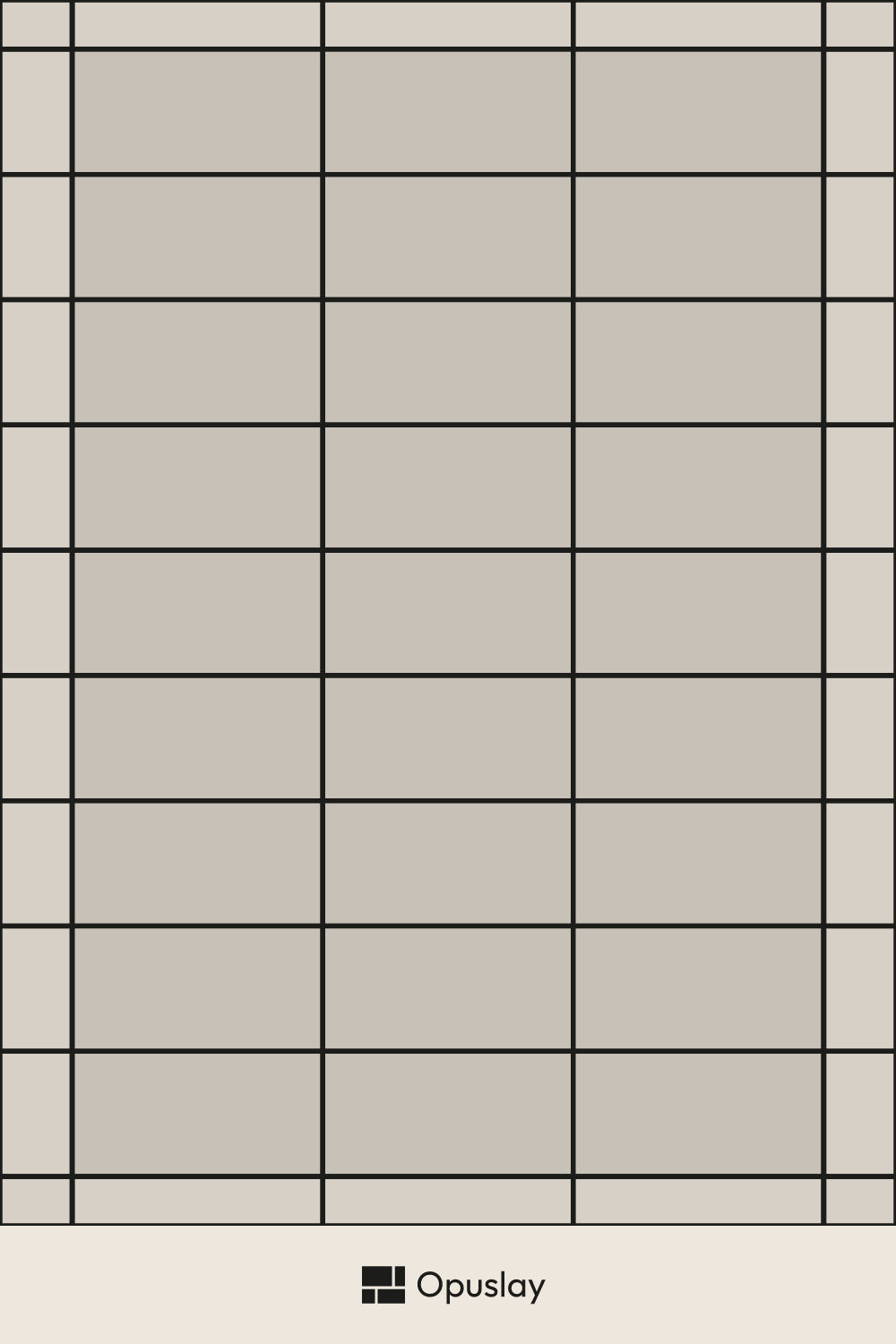
Stacked subway tile — also called stack bond or straight-set — lays the same 3"x6" subway-format tile with no offset between rows, so every vertical joint lines up in a continuous column. It uses the same tile as the classic running bond subway pattern, but reads as a clean, modern grid rather than a brick-like weave.
Last updated: 2026-07-12
One-Tile Pattern — 3x6 Subway (Straight/Stack Bond)
Opuslay — tile layout worksheet- Room:
- 3 m × 2.5 m
- Units:
- Metric (cm / m²)
- Anchor:
- Left · Top
- Layout angle:
- Straight
- Tile colours:
- Single colour
Material breakdown
| Format | Qty / Pattern | Share | Qty / Room | Area / Room |
|---|---|---|---|---|
| 7.62x15.24 cm | 1 | 100.0% | 660 | 7.50 m² |
| Total | 1 | 100% | 660 | 7.50 m² |
What you'll need to buy
Tiles to buy
| 7.62x15.24 cm | 693 tiles | 8.05 m² |
Total 693 tiles · 8.05 m² (incl. 7% cuts & breakage)
- Thin-set adhesive: ≈ 1 bag (22.7 kg) — recommended trowel: 6mm notch
- Grout — the tile sets the joint width, not you:
- ≈ 1 bag (11.3 kg) — 3mm joint, rectified / tight-set tile
- ≈ 2 bags (11.3 kg) — 5mm joint, natural or non-rectified tile
It's the tile that decides the joint, not the setter — dry-lay a section to find your width. Assumes 9.5mm tile depth; adjust for your product.
Share & export
Save the One-Tile Pattern — 3x6 Subway (Straight/Stack Bond) layout to your moodboard, or send the link to your tiler — it reopens with your room dimensions.
About the Stacked Subway Tile
Stacked subway tile is a simple grid arrangement rather than a historical style tied to a specific building or period, but it became a popular alternative to the traditional offset (running bond) subway layout as minimalist and contemporary kitchen/bath designs grew in the 2000s–2010s.
Because every joint aligns in both directions, a stacked layout places higher demands on tile size consistency (calibration) than a running bond layout, where slight size variation between tiles is visually absorbed by the staggered joints.
Frequently Asked Questions
What is stacked subway tile?
Stacked subway tile lays 3x6 subway-format tiles directly on top of each other with 0% offset (also called stack bond or straight-set), so vertical joints form continuous straight lines instead of the staggered brick pattern of a traditional running-bond subway layout.
Is stacked subway tile harder to install than running bond?
A stacked (stack bond) layout is generally considered more demanding, since perfectly aligned joints make any inconsistency in tile size or wall flatness immediately visible — installers often recommend rectified (precisely calibrated) tile for this layout.
Does stacked subway tile use less tile than a running bond layout?
No — tile quantity depends on wall area and waste allowance, not on offset. A stacked and a running bond layout at the same 3x6 size require essentially the same number of tiles for a given surface.
Can I combine stacked and running bond subway tile in the same room?
Yes, this is a common design choice — for example a stacked accent wall or niche paired with a running bond field — but it's treated as two separate layout calculations, one per pattern.
Want the classic brick-look offset instead? See the classic running bond (brick offset) layout